The Day I Paid Off the House, My Husband Suggested Putting It in His Mother’s Name “For Safety” — I Didn’t Argue, I Just Signed One Paper, and the Next Morning His Whole Family Went Silent
My husband asked me to hand my house to his mother like it was the most normal thing in the world. When I understood why, my smile felt colder than anger.
My name is Rebecca.
I was thirty-seven, working remote claims management for a healthcare company based out of Atlanta, living in Knoxville, Tennessee, in a white clapboard house with a deep front porch and two climbing rose bushes I had planted myself.
I bought that house before I married Daniel.
The down payment came from my father’s life insurance after he died.
The last mortgage payment came from my checking account eleven years later.
That night, I laid the letter from the lender on the dinner table like it was something holy.
Mortgage paid in full.
I thought Daniel would at least look proud.
Maybe relieved.
Maybe grateful enough to touch the paper the way people touch proof of a life they built together.
Instead, he glanced at it once, leaned back in his chair, and said to his mother, “Now we should probably move the house into your name, Mom. Just to keep it safe.”
There are moments when a room changes temperature without anyone touching the thermostat.
That was one of them.
His mother, Linda, set down her fork so gently it made the moment worse.
“That would be the smart thing,” she said. “If anything ever happens, the property stays in the family.”
In the family.
I was sitting right there with cornbread crumbs still on my fingertips, and she said it like I was a temporary tenant overhearing grown people talk.
Daniel still wouldn’t look at me.
“It’s just protection,” he added. “Paperwork stuff. Taxes. Liability. Better to keep it with family.”
His sister Cassie gave a little smile into her glass.
Not a full smile.
Just the kind women wear when they think the outcome is already theirs.
If I had stood up then, they would have called me dramatic.
If I had cried, they would have called me emotional.
If I had shouted, they would have said money had changed me.
So I didn’t do any of those things.
I lifted my water glass, took one small sip, and smiled.
“Sure,” I said. “If that’s what makes everyone feel safe.”
Linda relaxed so quickly it bordered on smug.
Cassie looked at Daniel like the game was over.
And Daniel finally looked at me, surprised by how easy I had made it.
Then I asked, “When were you thinking of handling the paperwork?”
Linda answered for him.
“Tomorrow would be best.”
I nodded.
“Tomorrow is fine.”
Then I stood, cleared the plates, wiped the counters, refilled the coffee, and moved through my own kitchen like a calm woman who had just agreed to a sensible family decision.
By the next morning, they all thought I was on my way to sign the house over.
They were only wrong about one thing.
The paper I signed had nothing to do with giving them my home.
And by breakfast the following day, not one person in Daniel’s family could say the word safe without choking on it.
If you think silence always means surrender, keep reading.
That night, I was silent.
But I was not giving up.
The truth is, Daniel never really loved the house.
He loved being seen as the man who owned it.
Those are two different things.
When we first got married, he used to walk friends through the living room with one hand in his pocket and the easy pride of a man people assumed had built something solid. He never directly lied. He just let them misunderstand.
And for years, I let them.
When I was younger, I thought marriage meant sometimes carrying your spouse’s ego so life would feel lighter for both of you.
What I learned later was harsher.
Some people don’t ask you to carry their ego.
They set it on your back and call it partnership.
The mortgage came out of my account every month.
So did the property taxes, the homeowners insurance, the new water heater in 2019, the porch repair after the storm, the HVAC replacement the winter before this story began. Daniel contributed sometimes. But his income came in the way spring rain comes in East Tennessee.
Nice when it happens.
Dangerous to depend on.
He had changed jobs four times in six years.
Insurance sales, then real estate, then “logistics consulting” with a cousin who couldn’t even keep his own phone on, then a commission-heavy finance position that always sounded more successful in his mouth than it ever looked in our bank statements.
Every time he failed, Linda said the same thing.
“Rebecca’s steady. One solid person in a marriage is enough.”
It sounded like praise.
It wasn’t.
In that family, steady meant useful.
Steady meant reliable.
Steady meant you could lean on me until the floor beneath me cracked and still act surprised when I asked why nobody noticed.
About three months before the mortgage was paid off, Daniel started asking odd questions.
Where did I keep the original deed packet?
What was the login for the county tax account?
If people wanted to “restructure” property ownership later for planning purposes, was it complicated?
Nothing dramatic.
Nothing illegal on its face.
Just enough to smell wrong.
And Daniel was never subtle enough to hide the smell of money.
A week before the house was officially mine and mine alone, I came home early because a client call got canceled.
Linda was at the table with Daniel.
They didn’t know I had come in through the garage.
I heard her voice before I saw either of them.
“She can’t give you children,” Linda said. “If this marriage goes bad, the least you can do is make sure the house stays on our side.”
I stopped in the doorway between the garage and kitchen and stood perfectly still.
Daniel didn’t argue.
That was the part that hurt most.
He didn’t say, Mom, stop.
He didn’t say, It’s Rebecca’s house.
He didn’t even say, That’s not fair.
He only asked, “What if she gets suspicious?”
Linda answered immediately.
“Then you tell her it’s for safety. For taxes. For family planning. She hates conflict. She’ll swallow it.”
There are times your own heartbeat sounds like someone knocking from inside a wall.
That was one of them.
I didn’t walk in.
I went back to the car, shut the door, and sat there for ten full minutes with my hands on the steering wheel and dead leaves stuck to the windshield. I understood something ugly and clean all at once.
I had not been loved as a wife inside that conversation.
I had been managed as an asset.
After that, I started pulling everything together.
Bank statements from the original down payment.
Proof the source was my father’s insurance benefit.
Every mortgage payment record tied to my account.
Tax records.
Repair invoices.
Email chains with the lender.
Then I found something else.
The year before, Daniel had quietly signed as guarantor on a business loan for his cousin Mark. That business was failing. The lender was circling. If the debt came due, Daniel could be dragged right into it.
Suddenly, his suggestion about putting the house in his mother’s name “for safety” no longer sounded like family caution.
It sounded like a plan.
A plan to move the property out of reach before his financial mess caught up with him.
A plan to place it under Linda’s name so the house I bought, maintained, and finally paid off would remain conveniently available to his side of the family if I ever stopped being useful.
That dinner conversation wasn’t spontaneous.
It was timing.
The next morning, instead of going to the title office Linda had probably already pictured in her head, I drove downtown to see Harvey Boone, the attorney who had handled my father’s estate years earlier.
Harvey was in his sixties, silver-haired, slow-speaking, and careful in the way only lawyers with conscience and experience become careful. He read everything without interrupting me once.
When he finally looked up, he said, “Rebecca, if your husband is trying to move this property in anticipation of creditor exposure, any transfer could become a legal disaster. For him. Potentially for you too.”
I asked the only question that mattered.
“What do I sign if I want the house protected?”
He held my gaze for a long moment.
Then he slid a document across the desk.
Not a deed.
Not a transfer form.
A divorce petition.
Along with a request for the court to recognize the home as separate property purchased before marriage through separate funds, plus a temporary order preventing Daniel from transferring, encumbering, or inviting extended family into any claim against it.
One paper.
One signature.
One clean cut.
I signed.
When I walked back to my car, Knoxville looked almost offensively normal.
Blue sky.
Coffee shop noise.
A dog tied outside a bookstore.
People crossing the street with grocery bags and no idea a marriage had just been placed in formal writing like a body on a steel table.
I didn’t cry.
Not because I was strong.
Because once pain finally takes the exact shape you feared, tears can start to feel too small for it.
That night, I went home.
I made salmon.
I asked Daniel if he wanted lemon.
I took Linda’s call when she said she and Cassie were coming for breakfast the next morning to “celebrate the smart next step.”
I told her that sounded lovely.
And I let them all believe they were about to watch me hand over the house with a smile.
In a way, they were right.
There would be papers.
There would be witnesses.
There would be silence when it was done.
Just not the kind they had planned for.
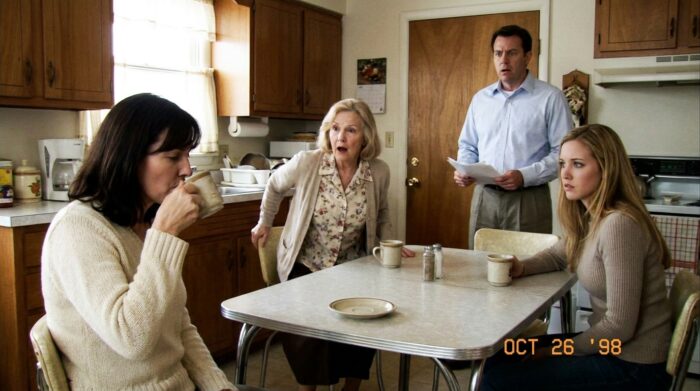
Linda arrived at 8:15.
Cassie came with her, carrying a store-bought pastry ring as if she were attending some tasteful family transition rather than the attempted theft of a woman’s life.
Daniel wore a pale blue button-down. He smelled like shaving cream and certainty.
I made coffee.
I fried bacon.
I set out the plates.
No one noticed my hands were no longer shaking, because by then, they weren’t.
Linda kept looking around the kitchen with the satisfied gaze of a woman already rearranging cupboards in her mind.
“You know,” she said, stirring sugar into her cup, “once things are in my name, I may make a few changes around here. Better flow. Better energy.”
Cassie smiled into her coffee.
Daniel said nothing.
At exactly 8:31, the doorbell rang.
Daniel got there first, almost eager.
When he opened the door, he found a blonde woman in a gray blazer holding a legal envelope, accompanied by a deputy from the sheriff’s office.
I recognized her immediately.
The process server from Boone & Parker.
Daniel did not.
“Mr. Holloway?” she asked.
He nodded.
“You’ve been served.”
The whole house dropped into silence so suddenly I could hear the refrigerator motor kick on.
Linda stood up. “Served with what?”
The woman glanced at me with professional courtesy, then answered clearly.
“Petition for divorce, request for separate property determination, and temporary injunctive relief.”
Cassie actually whispered, “What?”
Daniel opened the packet. His face drained by degrees as he read. He got to the words separate property and temporary restraining order and looked up like someone had just translated his own reflection into a language he hated.
“You filed for divorce?” he asked me.
I nodded once.
“Yesterday morning.”
Linda gave a brittle laugh. “Over one cautious suggestion?”
“No,” I said. “Over a plan.”
Then I reached into my bag and laid copies on the table.
Bank statements.
The original down payment trail.
The lender confirmation.
Repair payments.
And finally, the transcript Harvey’s office had prepared from the garage security audio I legally owned.
Linda’s own words.
She hates conflict. She’ll swallow it.
Daniel stared at the pages but didn’t touch them.
Cassie finally found her voice. “This is insane. We were trying to protect family.”
I looked at her.
“I am family,” I said.
That shut her up for exactly three seconds.
Then Linda turned vicious, because losing control always makes people tell the truth faster.
“You’re doing this because you never had children,” she snapped. “You don’t understand what legacy means.”
Daniel said, “Mom,” but too late and too softly.
I almost laughed.
Not because it was funny.
Because it was the same knife she had reached for on my porch, in my kitchen, in side comments for years. When kindness stops working for women like Linda, they go for the wound they assume has never stopped bleeding.
I stood then.
Slowly.
“There it is,” I said. “You wanted the house because you thought I would be too ashamed of what I didn’t have to defend what I built.”
No one answered.
I kept going.
“You all made the same mistake. You thought my silence meant I didn’t understand. It meant I was waiting until I had enough proof that none of you could rewrite the story later.”
Daniel finally stepped forward.
“Rebecca, we can fix this.”
That sentence would have destroyed me a year earlier.
That morning, it only made me tired.
“No,” I said. “You can’t fix a thing you didn’t break by accident.”
He lowered his voice like that would soften the betrayal.
“I wasn’t trying to take the house from you.”
I met his eyes for the first time that morning.
“Then why wasn’t my name the one you were trying to protect?”
He had no answer.
That was the moment I knew, more than the paperwork, more than Linda’s face, more than the process server still standing at my open door.
Not because he was guilty.
Because he was empty where a defense should have been.
He sat down hard in the chair nearest him.
Cassie started crying, though nothing had happened to her except the loss of an outcome she liked.
Linda, however, was still trying to recover her footing.
She drew herself up and said, “If you go through with this, you will destroy this family.”
And there it was again.
That word.
Family.
Used like a crowbar.
Used like a debt note.
Used like permission to eat through another woman’s life and call it belonging.
I stayed very calm when I answered.
“This family started trying to destroy me the moment it decided I was safer to use than to respect.”
The deputy at the door looked away.
The process server lowered her eyes toward her folder.
Daniel rubbed both hands over his face and muttered, “God.”
But the strangest thing happened next.
Linda sat back down.
Very quietly.
And for the first time since I had known her, she looked old rather than powerful.
Not softened.
Not humbled.
Just suddenly visible as the kind of woman who had spent so long moving people around like furniture that she couldn’t understand why one of them had finally stood up and walked out of her arrangement.
The emotional peak didn’t come when I filed.
It didn’t come when Daniel was served.
It came when I picked up the lender’s final payoff letter from where it still lay at the center of the table, smoothed it once with my palm, and realized I had paid for this house in more ways than money.
I had paid with time.
With delayed motherhood.
With overtime.
With forgiveness I should never have had to manufacture.
With years of making myself smaller so other people could keep their illusions intact.
And still I had not turned cruel.
That mattered to me more than it mattered to them.
So I did one last thing no one there expected.
I slid a second envelope across the table toward Daniel.
He looked at it warily.
Inside was a copy of the failing loan guarantee he had signed for Mark, along with a note from Harvey about why transferring the property now could be interpreted as fraudulent conveyance.
Daniel read the first page, then the second, then looked up like the room had tilted.
“I didn’t know it had gotten this bad,” he said.
That, finally, was true.
Mark had lied to him too.
Linda had encouraged him anyway.
And Daniel, weak where he most wanted to look strong, had chosen the easiest target in the room to help absorb the consequences.
I didn’t feel triumph.
Only something colder and sadder.
Understanding.
“You were ready to protect a debt from me,” I said quietly. “But not me from the debt.”
No one spoke after that.
Not for a long time.
In that silence, all the little truths arranged themselves more honestly than words ever could.
Linda had not wanted legacy.
She wanted control.
Cassie had not wanted stability.
She wanted her side to win.
Daniel had not wanted safety.
He wanted an exit route that cost him less than integrity.
And I— the woman they expected to swallow— had signed exactly one paper and stopped an entire machine from using my life as collateral.
By noon, Linda and Cassie were gone.
They left without taking the pastry ring.
It sat untouched on my counter all afternoon, sugar glaze hardening under the kitchen light like evidence from a life that had ended before anyone finished breakfast.
Daniel stayed.
Not because I asked him to.
Because the temporary order required practical cooperation until his attorney responded, and because even men who have spent years avoiding consequences still have to stand inside them once they arrive.
He spent the afternoon making calls from the guest room.
Quiet calls.
Serious calls.
The kind that strip swagger out of a person by the third sentence.
I worked from the dining table with my laptop open and my headset on, appealing denied claims and correcting coding errors while my marriage cooled around me like metal.
That night, he stood in the kitchen doorway and said, “Were you ever going to tell me how much that house still meant to you?”
I didn’t look up from the sink.
“I thought buying it, paying for it, and maintaining it had said enough.”
He stood there a while longer, waiting for softness.
I had none to spare.
Two days later, he moved into an apartment over a tire shop owned by one of Nate-from-church’s cousins. Not a dramatic exile. Just the sort of place men land when their pride has finally become more expensive than their choices.
The divorce was not quick.
Nothing important ever is.
But it was clean.
Harvey proved what needed proving. The house had been purchased before the marriage with separate funds. My records were thorough. Daniel’s explanations were weak. The attempted transfer discussion, paired with the timing of his guarantee exposure, made his side look exactly as calculated as it had been.
I got the house.
There was never really a legal path for them to take it once the truth was organized.
That, too, taught me something.
Sometimes evil feels enormous only because it arrives loud.
But paperwork, timing, and one steady hand can be louder than panic if used correctly.
Linda told everyone I had overreacted.
Then she told a different set of people that I had trapped Daniel.
Then she told one cousin I had “always cared more about the house than the marriage.”
I let her talk.
People like Linda survive by revising.
I survived by documenting.
Cassie unfriended me everywhere and posted quotes about betrayal and cold women for three straight weeks. I muted her before the second one.
Daniel texted three times after he moved out.
The first to ask whether there were still winter clothes in the attic.
The second to say he never meant for it to happen like that.
The third, months later, to tell me Mark had declared bankruptcy and that if I had signed what they wanted, we both might have lost everything in litigation.
That was the closest thing to an apology I ever got.
I didn’t answer any of them.
Spring came slowly that year.
The roses on the porch bloomed late. The mail still arrived at 11:12 most mornings. The floorboard near the pantry still clicked once if I stepped on it too quickly with wet feet. In other words, the house remained exactly what it had always been.
Not a prize.
Not revenge.
A place I had built safety into with my own life.
One Saturday in May, I repainted the spare bedroom— the room Daniel had once called his office when he was trying on ambitions— and turned it into a reading room with an old green chair I found at an estate sale. I put a lamp by the window. Stacked books along the wall. Hung one photo of my father above the shelf, the one where he is smiling beside a truck that no longer exists.
That afternoon, while I was still sitting cross-legged on the floor with paint on my wrist, my neighbor Mrs. Bell knocked on the open screen door and handed me a lemon pie.
No speech.
No gossip.
Just pie.
As she turned to leave, she said, “You looked real calm that morning. I knew it was going to be bad for somebody.”
I laughed harder than I had in months.
Not because it was funny.
Because it was true.
Some women are loud when they finally stop being used.
Some of us become very, very calm.
A few weeks later, I found the original mortgage payoff letter tucked between two cookbooks where I must have hidden it during the legal rush. I sat down at the table and read it again slowly.
Paid in full.
Those three words meant something different now.
Not just the house.
Something in me too.
I put the letter in a frame and hung it inside the pantry door where only I would see it.
That felt right.
Not everything meaningful needs the wall.
The last time Daniel came by, it was to collect a box of old tax folders. He stood on the porch, thinner, quieter, looking at the rose bushes like they belonged to a place he had once visited rather than lived in.
Before he left, he said, “I really did think you’d just say yes.”
I nodded.
“I know.”
He looked down at the box in his arms.
“That’s the part that bothers me now.”
I believed him.
And still, I closed the door.
Not hard.
Not cruelly.
Just fully.
That night, I made tea, opened the windows, and let the Tennessee air move through the kitchen I had once defended in silence. The house settled around me with its old familiar sounds. Pipes. Wood. The low hum of the refrigerator. A life returning to its rightful owner one ordinary noise at a time.
Sometimes the most haunting ending is not revenge.
It is a woman sitting alone in the home she protected, realizing peace sounds smaller than victory and lasts much longer.
If you stayed with me through this one, follow the page. There are more stories here about the quiet moment someone finally stops mistaking your patience for permission.