The Widow Cut Her Husband’s Biker Vest Apart in Front of His Club — Then We Saw What She Was Sewing for His Final Ride
The first cut went straight through the black leather vest her husband had worn for thirty-two years, and every biker outside our clubhouse rose as if she had just struck the dead man himself.
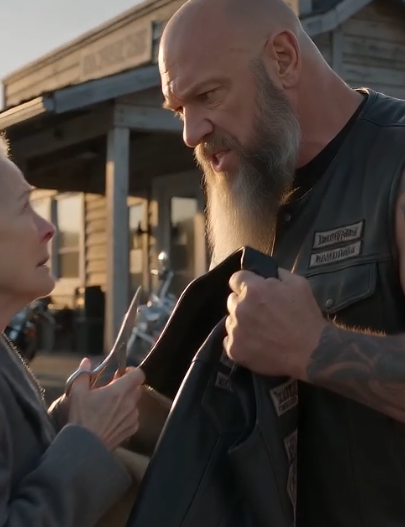
I was standing ten feet away when Eleanor “Ellie” Mercer drove those silver dressmaking shears beneath the left shoulder seam of her husband’s cut.
The leather resisted.
Then it surrendered with a sound I still hear in my sleep.
Rip.
Nobody moved at first. Behind us, the cooling Harley engines ticked beneath the late October sun, and the air outside the Iron Creek Riders clubhouse smelled of gasoline, fallen leaves, and the coffee somebody had forgotten on the porch rail.
Ellie pulled the scissors free and cut again.
Rip.
“Ma’am,” our youngest prospect whispered. “You need to put those down.”
She did not even look at him.
At sixty-three, Ellie was small enough to disappear inside her gray wool coat. Her silver hair had escaped its bun, and the cold wind kept pushing it across a face that looked emptied of everything except purpose.
On the folding table before her lay the vest of Samuel “Preacher” Mercer, our club president, my closest friend, and her husband of thirty-seven years.
Preacher had died six days earlier.
He had been sixty-six, six-foot-four, and built like a man who could still lift an engine block after breakfast. His beard had gone white, but his tattooed forearms remained thick, and his black leather vest carried more history than most county museums.
Now Ellie was destroying it.
Our road captain, Frank “Bear” Donnelly, stepped off the porch. Bear weighed nearly three hundred pounds and had buried friends in three different states, yet his hands trembled when he saw the torn leather.
“That cut belongs to the club,” he said.
Ellie kept working.
On the back of the vest was the large Iron Creek Riders emblem Preacher had worn through thunderstorms, funerals, charity runs, broken ribs, and more than two hundred thousand miles of American highway.
Above it sat his name.
Below it was a narrow patch reading ORIGINAL SEVEN.
There were smaller patches along the front: memorial rides, veteran fundraisers, blood drives, a faded American flag, and a crooked strip Ellie had sewn by hand after their twentieth anniversary.
Bear moved closer.
“Ellie, I know you’re angry.”
That made the other men glance at one another.
Preacher had spent more nights at the clubhouse than any wife should have tolerated. He had missed birthdays, canceled dinners, and once left their anniversary meal untouched because a brother’s daughter had broken down eighty miles outside Flagstaff.
We knew Ellie had reasons to resent that vest.
Maybe grief had sharpened every old wound.
Maybe she blamed the club for the years the road had taken from her.
Bear reached toward the scissors, but Ellie snapped them shut and finally raised her eyes.
“If one of you touches this vest,” she said, “I swear I’ll finish the cutting inside my car where none of you can watch.”
Twenty-eight bikers froze.
Then she turned the vest over, slid one shaking hand beneath a patch near the heart, and began cutting around it with the care of a surgeon.
That was when I noticed the canvas bag beside her chair.
A square of dark green fabric peeked from its open mouth. Sewn across it were pieces of old flannel, denim, and one familiar strip from Preacher’s favorite red work shirt.
I thought it was a pile of rags.
I was wrong.
Ellie cut the first patch free, pressed it against her chest, and whispered something too soft for the others to hear.
I heard it.
“Your brothers are here, Sam.”
Then she looked past us toward the clubhouse doors and asked for twenty-seven men by name—living, dead, retired, estranged, and buried.
Bear’s anger disappeared.
Mine did too.
Because Ellie was not tearing Preacher’s life apart.
She was gathering every piece of it, and before the sun went down, we would learn why her husband had made her promise to use those scissors.
Want to know why Preacher asked Ellie to cut apart his beloved vest and what she was making for the final night beside him? Drop PATCH in the comments — I’ll share more soon.
I had met Preacher in 1997, outside a truck stop on Route 89 near Flagstaff, Arizona.
My Harley had thrown a belt before sunrise. I was twenty-eight, newly sober, furious at the world, and too proud to admit that I had neither the tools nor the money to get home.
Preacher stopped anyway.
Back then his beard was brown, his shoulders were wider, and only three patches marked his vest. Ellie rode behind him in a faded denim jacket, holding a paper cup of coffee between both hands.
He repaired my motorcycle without asking my name.
When I thanked him, he nodded toward the bottle-shaped bulge in my saddlebag.
“Throw that away before you ride.”
I told him to mind his own business.
He looked at me for a long moment.
“Brother, you’re sitting beside my road. That makes you my business.”
I poured the bottle into the gravel.
Three months later, I joined the Iron Creek Riders.
Preacher never claimed to have saved me. Men like him rarely spoke about what they did for people because talking would have made the kindness feel smaller.
He simply called every morning for ninety days.
Sometimes he asked about my sobriety. Usually he asked whether my motorcycle was running.
Ellie knew what those calls meant.
She knew why strangers appeared at their kitchen table at midnight, why a frightened teenager once slept on their couch, and why Preacher kept spare groceries in the garage beside the motor oil.
She also knew the price.
The club got the strong version of him. Ellie often received whatever remained.
There were dinners reheated twice, anniversaries delayed by roadside emergencies, and Sundays when she sat alone in church while Preacher escorted another dead veteran to a cemetery.
Their marriage was not the polished thing people invent after someone dies.
It was real.
It carried scratches.
Once, after Preacher missed Ellie’s birthday to help Bear search for his runaway son, she locked his vest in the garden shed. He spent the night on the porch rather than wake her.
At dawn, she opened the door and found him asleep against the wall with a gas-station cupcake balanced on one knee.
A candle stood in its frosting.
She laughed before she could stay angry.
That became their rhythm. Preacher disappeared to hold someone else together, and Ellie reminded him that his own home also required hands.
She repaired the vest whenever he returned.
Her stitches were everywhere once you knew how to see them: beneath the collar, beside the pockets, along the torn lining, and around the crooked anniversary strip.
Her thread had kept the leather intact for decades.
Perhaps it had kept him intact too.
Five years before his death, Preacher was diagnosed with pulmonary fibrosis. His lungs slowly hardened, turning every breath into work.
He continued riding until he could no longer lift the Harley from its stand without help.
Then he parked it.
That nearly broke him.
During his final winter, the club rotated visits to the Mercer house. We brought groceries, fixed gutters, shoveled snow, and pretended not to notice the oxygen tube running beneath Preacher’s nose.
Ellie did not pretend.
She measured medication, changed sheets, argued with doctors, and slept lightly enough to hear every altered breath.
One February night, I found her sewing beside his bed.
A quilt covered his legs. It was made from squares of their shared life: denim from overalls, cotton from old curtains, flannel from camping shirts, and a piece of floral fabric I recognized from Ellie’s first club picnic.
Preacher caught me staring.
“She’s putting me back together,” he said.
Ellie did not smile.
“I’m repairing your blanket.”
“Same thing.”
He laid one scarred hand across the unfinished corner.
“This spot needs the cut.”
Ellie’s needle stopped.
“No.”
“Needs the brothers.”
“No, Sam.”
He turned his head toward me, but the conversation was not mine to enter.
“That vest belongs to the road,” she said.
Preacher’s breath rattled softly.
“No. It belongs to whoever carries me home.”
I did not understand then.
Ellie did.
That was why she had brought the scissors.
Outside the clubhouse, nobody spoke while Ellie removed each patch.
The large back emblem came first. She trimmed close to the embroidered border, leaving just enough leather to hold the stitching.
Next came Preacher’s name.
Then ORIGINAL SEVEN.
Then the smaller pieces marking rides and losses.
Each patch awakened a memory.
The faded blood-drive patch came from a weekend when Preacher persuaded eighty-seven bikers to donate after a local child needed emergency surgery.
The tiny winged wheel honored Tommy Vale, our first road captain, who had died of cancer before who had died of cancer the club owned its building.
A strip reading MILES FOR MAYA came from a charity run for Bear’s granddaughter.
Bear touched it with one finger.
“She’s twenty-one now,” he said. “Starts nursing school next month.”
Ellie nodded.
“Sam knew.”
Her voice broke slightly on the last word, but she continued cutting.
That frightened me more than tears would have.
Grief had given her a task, and the task was the narrow bridge keeping her above the darkness. If we took the scissors away, she might fall.
The trouble began when she reached the small inside pocket.
Preacher had sewn a plain black patch across it years earlier. No words. No emblem. Just a rough square almost hidden behind the leather fold.
Ellie opened the scissors.
Bear caught her wrist.
He did not squeeze, yet everyone saw the warning in his posture.
“Not that one.”
Ellie’s eyes hardened.
“Let go.”
“That patch stays.”
“Why?”
Bear looked at me.
I knew.
Inside the hidden pocket was the only piece of Iron Creek history we had never explained to families.
Twenty-two years earlier, a club member named Curtis “Hawk” Bell had disappeared with money collected for a burned-out family. Twelve thousand dollars vanished. So did Hawk.
Preacher refused to remove Hawk’s name from the founding roster.
Instead, he covered Hawk’s original patch with that black square.
“No man gets erased while the truth is unfinished,” Preacher had told us.
Most of us believed Hawk had stolen the money.
Ellie believed it too.
She looked from Bear to me, then slipped the scissors from beneath the seam.
“All right,” she said. “You cut it.”
I stepped forward.
The leather was cold beneath my fingers.
When my knife lifted the black patch, another layer appeared underneath. Hawk’s old name strip remained there, faded but intact.
Tucked behind it was a small envelope.
Preacher had written my road name across the front.
ROOK — WHEN THEY’RE ALL HERE.
Every member crowded closer.
My hands shook as I opened it.
Inside was one sheet of paper and a photocopy of a cashier’s check dated twenty-two years earlier. The check had been made payable to the Collins family, whose home had burned outside Sedona.
The amount was twelve thousand dollars.
Hawk had not stolen it.
He had delivered it anonymously after the insurance company threatened to seize it for outstanding debt. Then he had left the state because Preacher discovered he had been diagnosed with early-onset dementia.
The note explained that Hawk had asked Preacher to let the club hate him. Anger, he believed, would hurt less than watching a forty-one-year-old brother forget every face he loved.
Preacher had kept his promise.
Until now.
At the bottom of the page was an address in Oregon.
Hawk was still alive.
Bear backed away as though somebody had hit him.
For twenty-two years, he had called Hawk a thief.
Ellie lowered herself into the folding chair.
“Sam said one patch would need forgiveness before it could touch the quilt,” she whispered.
Nobody looked at Bear.
We did not have to.
He stared at Hawk’s faded name until the hard lines in his face collapsed.
Then he picked up his helmet.
“I’m going to Oregon.”
Ellie shook her head.
“You’re going after the funeral.”
“Why?”
“Because Sam asked for all his brothers to carry him first.”
Bear sank to one knee before her.
For a moment, the largest man in our club looked like a boy waiting outside a locked door.
Then Ellie placed Hawk’s patch in his palm.
“You can carry this one.”
We brought the quilt inside because the wind had strengthened.
The clubhouse had hosted loud celebrations, ugly arguments, wedding receptions, fundraisers, and more memorials than I wanted to count. That afternoon, it became a sewing room.
Ellie spread the quilt across our long meeting table.
Nobody laughed.
Twenty-eight tattooed men stood around floral cotton, worn denim, yellow dress fabric, and squares cut from an old man’s pajamas.
The empty center waited.
Ellie positioned the large Iron Creek emblem there.
It fit perfectly.
Around it, she arranged Preacher’s name, the anniversary strip, the fundraiser patches, and the memorial wings. Hawk’s patch lay near the lower edge, separated from the others by two inches of bare cloth.
“Sam designed this?” I asked.
“He tried.”
From her canvas bag, she removed a notebook.
Preacher’s hands had become unsteady near the end, so the pages were filled with crooked squares and arrows. Beside certain patches, he had written names.
The blood-drive patch was assigned to Maya Donnelly.
The veterans’ memorial belonged near the cloth from his Army shirt.
Our club emblem was marked simply: CENTER — HOME IS PEOPLE.
Then Ellie turned to the final page.
There were twenty-eight blank lines.
“He wanted one piece from each of you,” she said.
Nobody understood.
“Fabric,” she explained. “From something that carried a memory with him. Nothing new. Nothing bought.”
A low murmur moved around the table.
Mason cut a strip from the bandanna he had worn during his first sober ride.
Luis removed the inside pocket of a work shirt Preacher had once repaired after a crash.
Bear stared down at Hawk’s patch, then cut the cuff from his own denim sleeve.
I went to my motorcycle and opened the left saddlebag.
At the bottom lay a red shop rag I had carried since the morning Preacher repaired my belt outside Flagstaff. It was stained with grease, sun-faded at the edges, and almost worn through.
I had never washed it.
I cut away the cleanest corner.
Ellie accepted every piece without commentary. She wrote each name on masking tape and pinned it to the fabric.
When all twenty-eight pieces surrounded the club emblem, the quilt no longer looked elegant.
It looked honest.
Nothing matched.
That was the point.
For the next nine hours, we worked.
Most of us could rebuild a carburetor, replace brake lines, or diagnose an engine by sound. Few could thread a needle.
Ellie taught us.
She showed Bear how to push the needle without splitting the embroidery. She made Mason remove three crooked stitches and do them again. She slapped my hand when I pulled the thread too tight.
“Leather needs room to move,” she said.
“So do people,” I replied.
She looked at me.
“That sounds like something Sam would say.”
“It was.”
For the first time that day, her mouth lifted.
Only slightly.
It was enough.
At midnight, the quilt was nearly complete. Twenty-eight men sat around the room beneath fluorescent lights, heads bowed over their sections.
The scene would have terrified anyone peering through the windows.
Huge shoulders. Scarred hands. Knuckle tattoos. Leather boots.
Every one of us sewing.
Then Ellie reached the final patch—the crooked anniversary strip she had made for Preacher seventeen years earlier.
Its lettering read: STILL COMING HOME.
She could not lift the needle.
Her hand shook once.
Twice.
Then the scissors fell from her fingers and struck the floor.
Ellie had spent six days arranging a funeral, answering phone calls, signing papers, feeding visitors, and finishing the task her husband had left her.
Now there was nothing left to organize.
She folded over the quilt and made a sound I had never heard from another human being.
It was not a cry.
It was the sound of a house collapsing after the fire had already gone out.
We stood helplessly.
Bear moved first.
He knelt beside her, but he did not tell her everything would be all right. He did not say Preacher was in a better place or offer any of the polished lies people use because grief frightens them.
He simply placed one massive hand beneath hers.
Together, they lifted the needle.
Ellie pushed it through the patch.
Bear pulled it out the other side.
One stitch.
Then another.
The club passed the needle from hand to hand until STILL COMING HOME was secured above Preacher’s name.
At 1:17 in the morning, the quilt was finished.
Ellie ran both palms across it.
“This isn’t his burial blanket,” she said.
Bear frowned.
We had all assumed that was what she meant by a final quilt.
Ellie looked toward the empty chair Preacher had used during meetings.
“He didn’t want it buried.”
She told us what he had actually planned.
And the scissors finally made sense.
Preacher did not want leather sealed inside a coffin.
He wanted the quilt carried for one night to every place that had made him who he was.
The old gas station where he met Ellie.
The overlook where the original seven formed the club.
The veterans’ cemetery where Tommy Vale rested.
The highway turnout where he had found me beside my broken motorcycle.
Then it would return to Ellie’s bed.
“He said the club could keep his Harley,” she told us. “But I was keeping the warmth.”
Nobody objected.
At dawn, we covered Preacher’s coffin with the quilt and carried him from the funeral home.
Rain had begun before sunrise. It fell gently, beading on the patches but never soaking through the heavy fabric.
The procession included forty-three motorcycles.
Preacher’s black Harley rode on a trailer directly behind the hearse. His helmet rested on the seat, and his gloves were wrapped around the grips.
Ellie rode with me.
She wore Preacher’s old leather jacket beneath her gray coat. It was too large, and the sleeves covered her hands.
Our first stop was a boarded gas station outside Flagstaff.
Preacher had met Ellie there in 1984 after she refused to sell him cigarettes because he was trying to pay with pennies and charm.
“He came back every afternoon for two weeks,” she said.
“For cigarettes?”
“He didn’t smoke.”
At the overlook, Bear unfolded one edge of the quilt and pressed Hawk’s patch against the stone wall where the founding members had once carved their initials.
Then he took out his phone and called the Oregon number.
A nurse answered.
Hawk could no longer speak clearly, but she held the phone to his ear.
Bear’s voice failed twice before he managed four words.
“I was wrong, brother.”
Through the speaker came a faint sound.
Not language.
Breath and effort.
Then one broken syllable.
“Bear.”
Frank Donnelly lowered his head against the quilt.
Hawk had forgotten almost everything.
He remembered him.
At the veterans’ cemetery, we stopped beside Tommy Vale’s grave. His widow waited beneath a blue umbrella.
She placed one of Tommy’s old patches on the quilt without asking.
Ellie sewed it beside the memorial wings while rain tapped softly on the umbrella.
Our final stop was the Route 89 turnout where Preacher had found me.
The truck stop had been renovated, but the gravel shoulder remained. I knew the exact place because a dark stain from spilled oil still marked the ground near the fence.
I laid my red shop rag against the quilt.
Ellie touched the faded cloth.
“Sam kept calling you because he was afraid you’d drink again.”
“I know.”
“No,” she said. “You don’t.”
She reached into her coat and gave me a folded note.
Preacher had written it during his last week.
Rook, you think I stopped because your bike was broken. I stopped because I recognized the way you were sitting. I sat that way once, before Ellie found me. Keep stopping.
That was all.
No grand farewell.
No speech.
Just an instruction.
Keep stopping.
When we returned to the clubhouse, hundreds of people lined the road. Families Preacher had helped stood beside veterans, nurses, firefighters, mechanics, recovering addicts, foster parents, and children now old enough to bring children of their own.
Most had never known one another.
Every one knew him.
We carried the coffin beneath the quilt.
The V-twins were silent.
Only boots sounded against the wet pavement.
Inside, Ellie removed the quilt before the burial. She folded it slowly, keeping each patch flat, then held it while the coffin was taken away.
The club emblem faced outward.
Not displayed behind glass.
Held against her heart.
Three days after the funeral, Ellie returned to the clubhouse.
We expected her to collect Preacher’s possessions.
Instead, she brought the quilt and a fresh spool of black thread.
“There’s still an empty space,” she said.
I examined every edge. “Where?”
She pointed to the section beside Hawk’s patch.
Preacher’s notebook had left that square unmarked.
Ellie finally understood why.
Two weeks later, Bear and I rode to Oregon.
Hawk lived in a memory-care facility outside Eugene, where pine trees pressed close to the windows and rain softened every sound.
He was sixty-eight but looked older. His hands had narrowed. His eyes wandered past us without recognition.
Bear sat beside him for nearly an hour.
No speeches.
No demands.
He placed the faded HAWK patch on the blanket covering his knees.
Hawk rubbed one thumb across the letters.
Then Bear took out the denim cuff he had cut from his sleeve and placed it beside the patch.
“I carried anger for twenty-two years,” he said. “You don’t have to carry it back.”
Hawk stared at him.
His lips moved.
“Ride?”
Bear swallowed hard.
“Yeah, brother. We rode.”
Before leaving, we asked the nurse for a piece of fabric from something Hawk used. She gave us a square cut from an old plaid shirt his daughter had brought years earlier.
Back in Flagstaff, Ellie sewed that square into the empty space.
She placed Bear’s denim cuff beside it.
The two pieces touched.
After that, the quilt stayed on Ellie’s bed.
Every Sunday evening, she brought it to the clubhouse for one hour. Members repaired loosened stitches, added memorial pieces, or simply rested their hands on the patched leather.
Nobody mounted Preacher’s vest behind the bar.
There was almost nothing left to mount.
We framed the empty leather shell instead—the cut shoulders, the ragged seams, and the spaces where each patch had once been.
Beneath it, Ellie placed the silver scissors.
Visitors sometimes assumed the ruined vest represented vandalism or revenge.
We never corrected them immediately.
We let them look.
Then we showed them the quilt.
A year after Preacher died, Ellie asked me to take her on a ride.
She climbed onto his restored Harley wearing the oversized jacket and held the quilt between us.
We followed Route 89 before dawn.
At the turnout where Preacher had first stopped for me, Ellie spread the quilt across the seat. Morning light touched the club emblem, Hawk’s faded name, Bear’s denim, my red shop rag, and the crooked strip she had sewn years before.
STILL COMING HOME.
Ellie sat beside it until the sun cleared the ridge.
“People thought I hated that vest,” she said.
“I thought you did too.”
“Sometimes I did.”
She smiled without apology.
“Sam gave so much of himself to the road that I occasionally wanted to burn the thing. But after he got sick, I understood something.”
She ran her fingers along his name patch.
“The vest never took him away. It showed him where somebody needed him.”
Before we left, Ellie wrapped the quilt around her shoulders.
The leather patches creaked softly as she climbed behind me.
I started the Harley.
The V-twin rumble rolled across the same gravel where Preacher had once found a drunk young man pretending he needed only a motorcycle repair.
In my mirror, Ellie held the quilt closed beneath her chin.
Behind us, twenty-seven headlights appeared along the highway.
Bear led them.
On the back of his vest was a newly sewn patch bearing two names:
PREACHER
HAWK
We rode home together.
Follow our page for more unforgettable biker stories about loyalty, loss, and the quiet acts of love hidden beneath leather, tattoos, and roaring engines.