A Biker Placed My Baby Inside a Harley Saddlebag During a Blizzard—Then Gave Us the Room He Had Kept Locked for Nine Years
The biker lifted my baby from my arms and lowered her into the black saddlebag of his Harley while snow erased the highway, and my scream disappeared beneath the wind before anyone could tell me whether he was saving her or stealing her.
I threw myself at him.
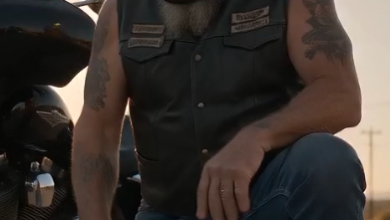
My hands struck leather, frozen metal, and a chest that felt like the side of a barn. He barely moved. The man stood at least six-foot-four, with a shaved head, a gray beard hanging over a weathered leather cut, tattooed hands, scarred knuckles, and the kind of face that made people check whether their car doors were locked.
“Give her back!”
He did not.
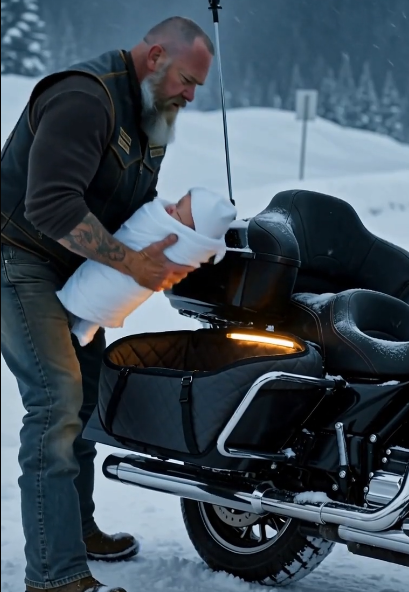
Instead, he bent over the open saddlebag and tucked my seven-month-old daughter, Nora, beneath a silver thermal blanket. A soft amber light glowed beneath her face. A small fan hummed somewhere inside the box, and strips of foam lined its edges, but all I understood was that a stranger had put my baby where luggage belonged.
I hit him again.
His right hand caught both of my wrists without squeezing them. His left remained beside Nora’s head, shielding her face from the snow.
“Ma’am,” he said, his voice rough and low, “your girl is too cold.”
“So put her in the truck!”
“The truck’s dead.”
Our SUV sat crooked beside Colorado Highway 9, half buried in a drift. The heater had stopped twenty minutes earlier. My phone showed no signal, Nora’s lips had begun losing their color, and the snow had swallowed every tire track behind us.
Still, a saddlebag was a saddlebag.
Then I saw the brass plate riveted inside its lid.
EMERGENCY INFANT WARMING UNIT—E. MERCER
The biker pressed two fingers against Nora’s neck, watched a tiny digital thermometer, and closed a clear insulated cover over the compartment. Air holes ringed the top. A battery indicator shone green beside a temperature gauge. Through the window, I could see my daughter breathing.
“Who built this?” I whispered.
“My girl and me.”
Before I could ask what that meant, three headlights appeared through the storm. More Harleys came crawling toward us, their V-twins thudding low beneath the wind, each motorcycle carrying chains, blankets, fuel bottles, and bright rescue markers. The riders formed a shield between us and the highway while the large man fastened the saddlebag’s safety cover.
One biker shouted that Route 9 had closed behind them. Another said the county shelter was full. The man beside Nora looked toward the white wall ahead and made a decision none of his brothers liked.
“We take the service road.”
“That road’s gone, Bear,” someone warned.
“Then we find it.”
He lifted me onto the pillion seat, clipped a heated wrap around my chest, and told me to keep one hand on his vest and the other over the clear window beside Nora. Beneath my glove, the compartment felt warm.
Before climbing onto the Harley, I noticed something stitched inside his leather cut: a tiny yellow patch shaped like a sun, with one name beneath it.
EMILY.
We rode into a storm that had already buried two cars and cut power across half of Summit County. I believed the heated saddlebag was the greatest secret this terrifying stranger carried.
I was wrong.
Hours later, he opened a locked bedroom in his house, and I saw that everything inside—from the untouched crib to the winter coat on the bed—had been waiting for a little girl who would never come home.
My name is Rachel Lawson, and before that night I knew almost nothing about motorcycles. I knew they were loud. I knew men in leather gathered around them outside bars and gas stations. I knew my mother used to lower her voice when she called someone a biker, as though the word itself meant trouble.
The man who saved Nora was named Wade Mercer, though every rider in the Iron Lanterns Motorcycle Club called him Bear. I learned his name while pressed against the back of his leather cut, following a road I could no longer see.
Bear did not ride fast. He rode carefully, which frightened me more.
The Harley’s rear tire moved through packed snow with a slow, deliberate pull. Chains clicked against the ice. Every few yards, his boots touched down to steady nearly nine hundred pounds of motorcycle, equipment, luggage, and two terrified passengers. The engine beneath us did not roar like it did in movies. It labored.
Through the clear panel beside my knee, Nora lay wrapped inside the warming compartment. Her eyes were closed, but her chest rose in small, steady movements. A green number on the thermometer climbed from 94.8 to 95.1.
I watched every decimal.
Bear had designed the compartment from a Harley touring case, but almost none of the original interior remained. Foam insulation covered the metal. A twelve-volt warming pad sat beneath a suspended infant liner so no hot surface touched the baby. A thermostat regulated the temperature. Two battery systems supplied power, and a hand pump could circulate air if the electric fan failed.
I did not know those details yet. I only knew warmth was reaching my child when I could not provide it.
The Iron Lanterns rode around us in a staggered formation. The club president, a broad Black man named Jonah “Atlas” Reed, took the lead. Behind us came Brick, Hollow, June Bug, and a young prospect everyone called Finch. Their leather creaked whenever they leaned. Their headlamps made dull tunnels through the snow.
They looked like the kind of men a frightened mother might avoid at a rest stop.
That night, they became moving walls.
At the first fallen pine, Atlas dismounted and tested the snow with an avalanche probe. Brick and Hollow dragged branches aside. Finch planted orange markers so county rescuers could trace our path later. Nobody wasted words. Bear kept one glove against the warming unit.
“Still breathing?” I asked.
“Yes.”
“How do you know?”
“I can feel the fan.”
It seemed impossible that he could feel anything through the glove, the steel, and the vibration of the engine. Yet when the fan stuttered ten minutes later, he stopped before I noticed the change.
Bear opened the side panel, exposed a cluster of protected wires, and replaced a small fuse. His fingers shook once. Only once.
Inside his tool pouch were spare connectors, pediatric warming packs, a pulse oximeter, sterile cloths, and a folded page covered in childish handwriting. I caught only three words before he pushed it back inside.
Daddy’s Snow Box.
“Your daughter wrote that?”
Bear closed the pouch.
“Long time ago.”
That was all.
We reached an abandoned road-maintenance shed after nearly forty minutes. Its doors were chained, but a narrow overhang blocked some of the wind. The riders parked their motorcycles in a semicircle, engines facing outward so exhaust could not collect near us, then unfolded an insulated shelter from two saddlebags.
They moved like a crew that had practiced this.
Inside the shelter, Atlas handed me warm electrolyte solution and asked about Nora’s medical history. He had been an emergency-room nurse for twenty-two years. June Bug, the smallest and oldest rider, worked as a volunteer radio operator. Brick maintained snowplows for Summit County.
Bear, I learned, repaired industrial refrigeration systems.
Cold was his trade.
Atlas examined Nora without removing her fully from the warming liner. Her skin remained pale, but her breathing had improved. Her temperature reached 96.2.
“She needs proper medical evaluation,” he said. “But Bear bought us time.”
Bought us time. Those words broke something inside me.
Until then, I had treated Bear as another danger competing with the storm. Now I stared at the man crouched outside the shelter, his beard stiff with ice, repairing a strap under the yellow beam of a flashlight. He had given me his heated gloves. His bare fingertips had turned red.
I crawled closer to the entrance.
“Why do you have this equipment?”
Bear kept tightening the strap.
“We run winter support.”
“For stranded drivers?”
“For whoever’s freezing.”
Atlas glanced at him, then at me. There was history inside that look.
Nine years earlier, Bear had not been the man who rode toward stranded families. He had been a refinery mechanic in Commerce City, a hard drinker, and the Iron Lanterns’ most reckless road captain. He missed birthdays, school plays, and parent conferences. When his wife, Dana, died from an aneurysm, he was left alone with their eight-year-old daughter, Emily.
He tried to change.
Trying came late.
Emily loved machines because they were the only language her father spoke without stumbling. She sat on a stool in his garage, handing him wrenches and naming every tool incorrectly on purpose. A socket wrench was a “clicking stick.” A torque wrench was a “don’t-break-it bar.” Electrical tape was “motorcycle bandage.”
Bear kept every name.
One winter, Emily drew a picture of a baby inside a glowing motorcycle box after they passed a stranded family near Breckenridge. Underneath, she wrote, Daddy should make this because cars get cold.
He promised they would.
They never finished it together.
The radio on June Bug’s shoulder crackled. A county rescue team had reached the northern service junction, but the main route remained blocked. The maintenance shed could not safely shelter us much longer. Temperatures were dropping toward zero.
Bear looked at Atlas.
“My place is six miles.”
Atlas shook his head. “Last bridge could be iced over.”
“My place has a generator, oxygen, and a clear radio antenna.”
“It also has that room.”
Bear’s jaw tightened.
For several seconds, the only sound was nylon snapping in the wind.
Then Nora cried.
It was weak, angry, and beautiful.
Bear turned toward the warming compartment so fast that his knee struck the frozen ground. He stared through the clear panel, and the brutal lines around his eyes softened.
“Good,” he whispered. “Keep fighting, little one.”
Atlas watched him, then nodded.
“We go to Bear’s.”
The club packed the shelter. Bear checked Nora’s straps twice, then a third time. As I climbed behind him, I saw the yellow sun patch again, hidden inside his vest where nobody would notice unless the leather opened.
Some men wear grief where the world can see it.
Bear wore his against his heart.
The service road narrowed until it seemed less like pavement and more like a memory under the snow. Atlas walked ahead with the probe. The motorcycles followed one at a time, their engines idling low enough that we could hear branches cracking above us.
Nora’s temperature reached 97 degrees.
Then the battery warning turned amber.
I tapped Bear’s shoulder and pointed. He saw it, raised one fist, and the entire formation stopped.
No panic. No shouting.
That frightened me too.
Bear knelt beside the saddlebag and connected a backup power lead running from the Harley’s auxiliary battery. The indicator blinked green, amber, then green again. Snow gathered across his shoulders while he watched it.
“What happens if it dies?” I asked.
“It won’t.”
“But if it does?”
“I warm her another way.”
“How?”
He finally looked at me.
“With everything I’ve got.”
A crack rolled through the trees.
Atlas shouted.
We moved.
A heavy limb dropped across the road behind Finch, cutting off the route back. Nobody was struck, but the sound triggered something in Bear. He froze with one hand on the throttle. His breathing changed. For an instant, he was no longer seeing us.
“Bear,” Atlas called.
No response.
Atlas walked through the snow and placed a hand against Bear’s helmet.
“Not that night, brother. This one.”
Bear blinked.
Then the Harley moved again.
I would learn later that the sentence had been used before. Not that night. This one. Atlas said it whenever Bear’s memory pulled him backward, because grief did not arrive politely. It dragged sights, sounds, and temperatures through time.
We reached the bridge near Blue River shortly after midnight. Wind had polished its surface into black ice. Below us, the creek was a white trench between dark pines.
Atlas crossed on foot, testing every yard. Brick followed with a rope secured around his waist. When they reached the other side, the riders fastened a line between two trees and clipped each motorcycle to it with recovery straps.
They argued over Bear’s turn.
“Transfer the baby,” Brick said. “Put her in the insulated sled.”
“No,” Bear answered.
“The bike slips, she goes with it.”
“The sled loses regulated heat.”
“We can wrap chemical packs around it.”
“Uneven temperature. Burn risk.”
Atlas stepped closer. “Bear, listen.”
“I built the unit for transport.”
“You built it in a garage, not for crossing an ice bridge in a whiteout.”
Bear’s face hardened. “It was tested.”
“By whom?”
“Me.”
“Carrying what?”
Silence.
Bear looked at the saddlebag.
“A twenty-pound tool roll.”
Nora weighed sixteen pounds. That fact did not comfort me.
The club faced an impossible choice. Leave her inside the stable warming environment attached to a motorcycle that could slide, or remove her into a sled that could cross safely but might expose her to lethal cold. Bear trusted the machine. Atlas trusted the rope and the hands of his brothers.
For the first time, the Iron Lanterns split.
Brick and Hollow wanted the sled. Finch sided with Bear. June Bug checked the wind and said we had perhaps eight minutes before visibility vanished completely. Their voices rose, and Nora began crying again inside the box.
“Stop.”
They all turned toward me.
I was the least experienced person there, the one who had nearly driven us into a buried drainage ditch, the mother who had mistaken a rescue device for a luggage compartment. But Nora was my daughter.
I placed my palm against the clear panel.
“We take the unit off the motorcycle.”
Bear stared at me.
I pointed to the four mounting bolts. “You said it was designed for transport. Did you make it detachable?”
His eyes narrowed, not in anger but calculation.
“Quick-release base,” he said.
“Then detach it. Put the whole compartment in the sled. Keep its battery connected.”
Nobody spoke for a beat.
Atlas grinned. “That’ll do.”
Bear did not smile. He moved.
Four locking pins came free. The entire insulated unit lifted away from the saddlebag frame, handles folding from both sides. Atlas and Brick placed it inside the rescue sled, packed blankets around it, and ran a power extension from a portable battery June Bug carried.
Bear attached three safety lines.
Then he added a fourth.
I crossed the bridge walking beside Nora. Bear walked on the other side, one hand gripping the sled and the other holding the guide rope. The Harley came later, Finch easing it across while Hollow and Brick controlled its balance.
Halfway over, the wind hit.
The sled shifted.
Bear dropped to one knee. His hand went through the crusted snow and struck the bridge deck. I heard the crack even through my hood.
He did not let go.
Atlas pulled from the front. I pushed from behind. Bear rose with two fingers bent at an ugly angle and kept moving until the sled touched snow on the far side.
Only then did he look at his hand.
“Broken?” I asked.
“Probably.”
“You need it splinted.”
“Later.”
He remounted the warming unit, curled his damaged fingers around the throttle, and rode the last two miles.
Bear’s house stood beyond a line of fir trees outside Blue River, a low cedar place beside a detached garage. The Iron Lanterns had installed a whole-house generator years earlier. Its steady hum greeted us before the porch light did.
Inside, the air smelled of coffee, wood smoke, leather, and something faintly sweet.
Cinnamon.
Bear carried the entire warming unit into the living room. Atlas placed Nora on a blanket near the fireplace and completed a fuller examination. Her temperature was 97.8. Her color had returned. When he touched her foot, she kicked his wrist.
“Strong response,” Atlas said.
I laughed and cried at the same time.
Bear stood behind us, snow melting from his beard. His broken hand hung beside him. There was blood across two knuckles, but he watched only Nora.
County rescue radioed that an ambulance could reach us after the southern road was cleared, perhaps three hours. Until then, we were safe.
Or so I thought.
Then the generator coughed.
The lights flickered.
Bear turned toward the garage before the room went dark.
Emergency lamps glowed along the hallway, low and blue. Nora startled but did not cry. Outside, the generator tried to restart, caught for three seconds, and died again.
Bear grabbed a flashlight.
“Fuel line’s icing.”
“With that hand?” Atlas asked.
“Need power for the warmer.”
“Nora can stay against her mother now. She’s stable.”
“House heat still needs power.”
Brick stood. “I’ll handle the generator.”
“You don’t know the bypass.”
“Then tell me.”
Bear was already pulling on his coat. Atlas blocked the door.
This was not an argument about machinery. I understood that much. Bear needed to be the one who fixed it because fixing things was how he kept terror from reaching him.
Nora whimpered against my chest.
Bear stopped.
The sound pulled him harder than Atlas’s hand ever could. He looked down at the infant beneath my coat, then toward the dark hallway.
“There’s another heater,” he said.
“Where?” June Bug asked.
Bear did not answer immediately.
His gaze settled on a closed white door at the far end of the hall. It had a brass lock above the handle and a strip of faded yellow ribbon tied around the knob.
Atlas spoke softly. “Brother, you don’t have to.”
“Yes,” Bear said. “I do.”
He took a small key from beneath his shirt. It hung beside two dog tags and a plastic bead shaped like a sun.
His injured hand could not turn it. After two attempts, he handed the key to me.
That was how I became the first stranger to open Emily Mercer’s room in nine years.
The air inside carried cedar, dust, and cinnamon lip balm. A narrow bed stood beneath the window, covered by a quilt patterned with motorcycles and yellow suns. Shelves held schoolbooks, polished stones, model engines, and a line of stuffed animals. A purple winter coat lay across the bed as if its owner might return and complain that somebody had moved it.
In the corner stood a crib.
Not an old crib from Emily’s infancy. This one was newer. Custom-built. A small radiant heater had been mounted safely above it, wired to an independent battery bank. Beside it sat diapers, sealed bottles, blankets, and infant-sized winter clothing with tags still attached.
I stared at Bear.
“You prepared this room for us?”
He shook his head.
“No.”
“Then for whom?”
“For whoever came next.”
On the wall above the crib was Emily’s drawing: a black motorcycle beneath falling snow, a glowing yellow box attached to its side, and a baby smiling inside. The words DADDY’S SNOW BOX had been written in purple crayon.
Below it hung a photograph of Bear with an eight-year-old girl. He looked younger, heavier, and meaner. Emily wore safety goggles too large for her face and held a soldering iron above a workbench.
Bear had not invented the warming compartment after losing her.
Emily had.
The idea was hers. She had drawn the first version after seeing the stranded family. She chose the yellow light because she said babies should wake beneath a sunrise. She insisted on a window so frightened mothers could see inside. She even suggested folding handles because, in her words, “What if the motorcycle gets stuck but the baby still has to go?”
That suggestion carried Nora across the bridge.
The twist was not the machine.
It was the room.
Bear had spent nine years maintaining a bedroom for a child who was gone while quietly preparing it for children he had never met. Every winter he replaced expired formula, batteries, warming packs, and medicine. Every spring he donated the unused supplies, then filled the shelves again before the first snow.
“No one has slept here?” I asked.
Bear looked at Emily’s coat.
“No.”
“Why keep it locked?”
His jaw worked.
“Because I’m not good at doors.”
Atlas turned away.
I would later hear the whole truth, but Bear gave it to me that night in fragments, each one forced out between tasks. Nine years earlier, during another blizzard, Emily had been staying with her aunt in Frisco. Roads were closing. Bear had promised to collect her before dark.
He had been drinking at the clubhouse.
Atlas took his keys.
Bear fought him.
While the men argued, Emily’s aunt tried to drive her home before the storm worsened. Their car slid from Highway 9 and landed beyond a snowbank where passing drivers could not see it. Her aunt survived with severe injuries.
Emily did not.
Bear blamed Atlas for taking his keys. Atlas blamed himself for not calling the aunt. Three members blamed Bear for drinking. The club almost broke apart. Two riders left permanently. For eleven months, Bear refused to speak to Atlas except during meetings.
Then he found Emily’s drawing beneath a stack of papers in the garage.
The machine was unfinished.
Bear completed it alone.
Its first working version overheated. The second drained the motorcycle battery. The third had poor ventilation. Atlas obtained medical guidance. Brick fabricated a safer shell. June Bug designed the independent power system. Hollow tested seals in a commercial freezer.
The project rebuilt the brotherhood one wire at a time.
It did not erase what happened. Nothing could. Bear remained responsible for the promise he had broken. Atlas remained the man who had stopped a drunk rider but failed to stop a desperate aunt. They never turned the tragedy into a clean story with one villain and one hero.
They built something useful from the wreckage.
Bear stepped into the room and removed Emily’s purple coat from the bed. He held it for a moment, then opened the closet and hung it on an empty hook.
That tiny movement cost him more than crossing the bridge.
“Put the baby here,” he said.
I carried Nora to the crib.
Bear switched on the independent heater. A yellow light warmed the quilt and touched the edges of Emily’s drawing. Nora stared upward, fascinated, then reached one hand toward the paper sun.
Bear made a sound like his breath had caught on something sharp.
He left the room.
Outside, Brick restored the generator. Heat returned through the vents. The Iron Lanterns gathered in the kitchen while Atlas splinted Bear’s fingers. Nobody mentioned the tears frozen in the lower edge of his beard.
At 3:42 a.m., the ambulance arrived.
The paramedics examined Nora and confirmed mild hypothermia that was resolving without complication. They wanted to take us to St. Anthony Summit Hospital for observation. I packed our things while Bear stood in the doorway of Emily’s room.
“You’re coming,” I told him.
“No.”
“Your hand is broken.”
“Atlas can drive me later.”
I stepped closer. “Nora needs the man who built her sunrise.”
His face tightened.
“I didn’t build it alone.”
“Then all of you come.”
The Iron Lanterns followed the ambulance to the hospital.
Not with roaring engines.
The roads remained dangerous, so they rode slowly, six headlights moving through the snow like lanterns someone had refused to let go dark.
Nora spent ten hours under observation. Her temperature stabilized. Her oxygen level remained normal. By afternoon, she was drinking formula and grabbing at the nurse’s stethoscope.
Bear sat in the emergency department with two fractured fingers, a sprained wrist, and six stitches across his knuckles. He refused pain medication stronger than ibuprofen because, as Atlas quietly explained, Bear had been sober for eight years and treated every potentially addictive drug with caution.
Another piece of him fell into place.
He had stopped drinking eleven months after Emily died. Not because the club ordered him to, and not because a judge threatened him. He stopped on the night the third prototype warmed a twenty-pound bag of rice for six continuous hours without exceeding the safe temperature range.
Bear wrote the date on the garage wall.
Then he poured every bottle in his house down the drain.
His sobriety anniversary and the machine’s first successful test were the same day.
While Nora slept, Atlas told me about the Iron Lantern Winter Watch. The club monitored mountain roads during severe weather, working within county volunteer protocols rather than behaving like self-appointed rescuers. They carried radios, thermal blankets, warning lights, fuel, first-aid supplies, and locator beacons. They did not chase ambulances. They did not interfere with professionals.
They filled gaps.
Bear’s warming unit had never carried a baby before Nora. It had transported insulin, protected blood products during a clinic outage, and warmed saline supplies for a stranded rescue crew. County lawyers would not approve it as a certified infant transport device, so the club described it as emergency warming equipment and used it only when exposure posed the greater immediate risk.
That distinction mattered to Bear.
“Your daughter was the first?” I asked.
Atlas nodded. “First child inside it. Bear prayed there’d never be one.”
Across the room, Bear sat with his splinted hand elevated. He was staring at a photograph on his phone. I assumed it was Emily.
It was Nora.
A nurse had taken it after we arrived: my daughter wrapped in a hospital blanket, furious and pink, gripping one strand of Bear’s beard. He looked terrified to touch her.
I sat beside him.
“Send me that picture,” I said.
He locked the screen. “Don’t know how.”
I smiled. “You can rebuild a climate-controlled saddlebag but can’t send a photograph?”
“Different wiring.”
For the first time, I heard Bear make something close to a joke.
My husband, Daniel, arrived that afternoon after road crews reopened Interstate 70. He had been working in Denver when our SUV failed and had spent the night calling hospitals, police departments, and shelters. When he entered Nora’s room, his face collapsed.
He held us both for a long time.
Then I introduced him to the man who had placed our baby in a Harley saddlebag.
Daniel looked at Bear’s size, tattoos, leather vest, broken hand, and gray beard. The same fear I had felt passed over his face. Then he saw Nora reaching toward Bear from my arms.
Daniel offered his hand.
Bear looked at his splint and gave him the other one.
“Thank you,” Daniel said.
Bear nodded once.
“That’s your girl.”
Three simple words. Yet I understood what he meant. Nora belonged in Daniel’s arms. Bear had never been trying to take her. Every action, even the frightening ones, had been designed to return her.
Before we left the hospital, Bear handed me the folded page I had seen in his tool pouch. It was not the original drawing from Emily’s wall. It was a photocopy covered in engineering notes written over purple crayon.
Emily’s childish labels remained visible beneath his measurements.
Baby bed.
Warm wind.
Mom window.
Carry handles.
Beside the window, Bear had written: Never cover. Parent must maintain visual contact.
That was why he positioned my hand against the clear panel during the ride. It was not only for Nora. It was for me.
“What does the E stand for on the brass plate?” I asked, though I knew.
“Emily.”
“And Mercer?”
He looked toward Atlas, Brick, June Bug, Hollow, and Finch.
“All of us.”
Bear had built the structure, but the club had made it safe. The brotherhood that almost shattered after Emily’s death had survived because none of them pretended loyalty meant agreeing with him. Atlas took his keys when he was drunk. Later, he challenged Bear on the bridge. Both choices made Bear furious.
Both were acts of love.
A month after the storm, Daniel and I returned to Bear’s house. We brought a framed photograph of Nora beneath the yellow hospital blanket and a small wooden sun Daniel had carved.
Bear opened Emily’s room without needing to be asked.
The crib remained in the corner. The emergency supplies had been replaced. The purple coat still hung inside the closet, but the bed no longer looked frozen in time. Bear had removed the dusty cover, washed the quilt, and opened the curtains.
Sunlight touched the drawing.
I placed Nora in the crib while Bear attached the wooden sun beneath Emily’s picture. Daniel handed him the photograph. Bear studied it, then set it on the shelf beside Emily’s polished stones.
“You said this room was for whoever came next,” I told him.
Bear nodded.
“We don’t have family nearby. Daniel’s job keeps him away some weeks. I need to know something.”
His shoulders stiffened, perhaps expecting repayment, paperwork, or another question about the machine.
I took a breath.
“Would you be Nora’s grandfather?”
Bear did not answer.
He walked to the garage.
I thought I had pushed too hard. Atlas, who had joined us for coffee, said nothing. He only looked toward the door and waited.
Bear returned carrying a small object wrapped in a shop rag. It was a yellow plastic sun, unevenly cut and drilled through the center. Emily had made it as a child for the first warming-unit prototype.
He fastened it to Nora’s diaper bag.
“Grandfathers fix things,” he said.
That was his answer.
Bear changed after Nora, though not in the way sentimental stories claim men change. His beard remained wild. His voice still sounded like gravel dragged across steel. He still frightened delivery drivers when he opened the door wearing his leather cut.
But Emily’s room stayed unlocked.
At first, Nora visited once a month. Bear installed a proper changing table, secured the shelves, and covered every outlet. He replaced the old crib with a certified modern one after learning its rail spacing no longer met current standards. He complained through the entire shopping trip and spent three evenings assembling it twice because the first alignment was off by less than an eighth of an inch.
He kept the purple coat.
Some things were allowed to remain.
The Iron Lanterns turned the detached garage into a winter-response workshop. County emergency managers helped them formalize equipment checks and training. A pediatric specialist reviewed the warming unit and suggested changes: better airflow monitoring, a second temperature sensor, faster visual access, and clearer labels warning that it was not a substitute for professional transport.
Bear accepted every correction.
Pride had already cost him enough.
They built three updated units. One stayed at Bear’s house. One went into the club’s support truck. The third was donated to a volunteer rescue team serving remote mountain roads.
A small brass plate appeared on each.
EMILY UNIT—KEEP THEM WARM. GET THEM HOME.
Bear refused news interviews. When a Denver station requested footage, he sent Atlas. When a motorcycle magazine asked to feature the modified Harley, Bear said the machine was not a showpiece.
“It’s a tool,” he told me. “Tools work better without applause.”
Still, people learned.
Strangers mailed knitted blankets, infant supplies, hand warmers, and donations. Bear inspected every item. Anything unsuitable for emergency use went to local shelters. Anything expired went into the trash, no matter how well-intentioned the donor had been.
He had become merciless about safety.
Every December, on the anniversary of Emily’s death, the Iron Lanterns rode to the bend where her aunt’s car left Highway 9. They did not hold speeches. They cleared snow from the small roadside marker, replaced its yellow reflector, and left a battery lantern beneath it.
The first year we joined them, Nora was eighteen months old.
Bear carried her through the snow inside his jacket. She wore a yellow hat and kept grabbing his beard. At the marker, he knelt and placed her mitten against Emily’s engraved name.
“This is your Aunt Emmy,” he said.
His voice broke on the last word.
Nobody looked away.
Grief did not make him weak, and privacy did not require pretending the moment had not happened. Atlas rested one hand on Bear’s shoulder. Daniel stood beside me. Six Harley engines cooled behind us, ticking softly in the snow.
On the ride back, the riders stopped at Bear’s house. Emily’s room filled with coats, helmets, boots, coffee cups, and Nora’s laughter. The bedroom that had once been sealed against the future now held so much noise that Bear had to step into the hallway.
I followed him.
“You okay?”
“Too many people.”
“You invited them.”
“Bad judgment.”
Through the doorway, Nora sat on Atlas’s lap, trying to place a yellow sticker across his nose. Brick was repairing a toy truck. June Bug had found Emily’s old storybook and was reading it aloud in a voice far too serious for a book about dancing penguins.
Bear watched them.
Then he smiled.
It was not a broad smile. Bear did nothing broadly except occupy doorways. One corner of his mouth lifted before he hid it behind his beard.
That was enough.
The room had not replaced Emily. Nora had not healed a wound that should never be described as healed. Bear still woke during storms. He still kept the original drawing above the crib. Sometimes he sat alone in the garage with the first failed prototype and remembered every version of himself he wished he could repair.
But the locked door remained open.
That mattered.
Three winters have passed since Bear carried Nora through that storm.
She calls him Grandpa Bear now.
She believes all grandfathers own motorcycles, know how to repair generators, and keep emergency crackers in every pocket. She also believes Harley saddlebags are called snow boxes. None of us has corrected her.
The original warming compartment remains attached to Bear’s black touring bike during winter patrols, though children are transferred through official rescue services whenever circumstances allow. Its clear panel has been replaced. Its wiring has been upgraded. The little yellow sun Emily made still hangs inside, protected behind transparent resin.
My daughter knows that sun belongs to another girl.
One evening, when Nora was nearly four, she asked why Emily never came to play. Bear sat on the garage floor beside her. His massive tattooed hands rested on his knees.
“Emily died before you were born,” he said.
Nora considered that in the serious way children consider truths adults spend years avoiding.
“Do you miss her?”
“Every day.”
“Does she know me?”
Bear looked at the glowing yellow compartment.
“I think she built you a warm place.”
Nora climbed into his lap and leaned against his chest. Bear wrapped both arms around her, careful as machinery, while snow tapped against the garage door.
That winter brought another whiteout. The Iron Lanterns were called to assist with traffic control near Hoosier Pass. Before Bear left, Nora inspected his equipment with a toy flashlight.
“Blankets?”
“Loaded.”
“Radio?”
“Loaded.”
“Baby sunrise?”
Bear looked at her.
“Always.”
He closed the saddlebag. The yellow light vanished behind black metal, but I knew it was there, waiting beneath the surface.
Outside, Atlas and the others idled at the end of the driveway. The V-twins made the windows tremble. Bear pulled on his gloves, kissed two fingers, and touched the small sun patch hidden inside his leather cut.
Then he mounted the Harley.
People who passed the Iron Lanterns that night probably saw only large men, dark motorcycles, tattooed hands, and leather silhouettes moving toward a dangerous stretch of road. They might have locked their doors. They might have warned their children not to stare.
I once saw the same thing.
Now I saw Atlas carrying medical supplies. Brick carrying tools. June Bug carrying a radio. Finch carrying road markers. And Bear carrying a little girl’s unfinished idea into every storm that followed her.
The motorcycles rolled toward Highway 9, red taillights fading into the snow one by one.
Bear’s disappeared last.
Follow our page for more powerful biker stories about misunderstood riders, tested brotherhood, hidden grief, and the quiet acts of courage waiting beyond the leather and engine noise.