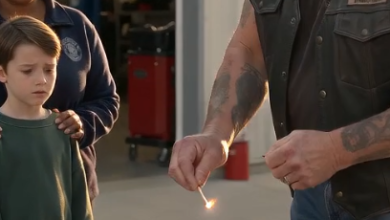
Part 2: A 62-Year-Old Biker Wouldn’t Let Anyone Touch His Cracked Helmet — Until His Granddaughter Added One Tiny Heart and Changed What It Meant Forever
Part 2
Grandpa’s house contained very little decoration.
He owned one painting, three family photographs, an old clock that ran seven minutes slow, and enough motorcycle-club patches to cover half the hallway. Everything else had a use.
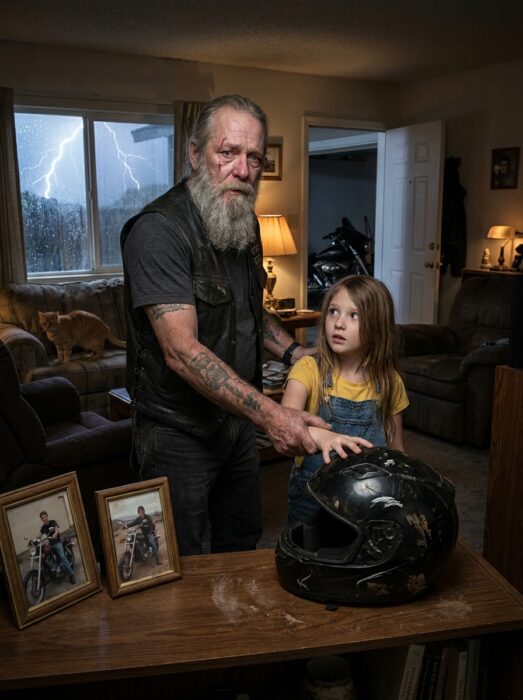
The walnut shelf beneath the helmet was the exception.
Grandpa had built it himself from dark wood salvaged from the Desert Star Diner before the restaurant was remodeled. He sanded the surface by hand, shaped the corners, and anchored it into the wall so firmly that my mother joked the house would fall before the shelf did.
He placed the helmet there twenty-seven years before I was born.
Nobody in the family knew the complete story.
My mother had heard fragments. She knew there had been a crash somewhere outside Seligman, during an August storm that turned the highway slick and red with desert mud. She knew Grandpa had spent two weeks in a hospital and several months learning to walk without a cane.
She also knew that another man had not come home.
Whenever she asked for details, Grandpa answered with one sentence.
“Danny died. I didn’t.”
Danny Vale had been Grandpa’s closest friend since they were fifteen. They met while working at a tire shop where both boys lied about their ages to earn full wages. Danny was skinny, quick-tempered, and funny enough to make customers forgive him for almost anything. Grandpa was already broad, quiet, and better with engines than people.
They balanced each other.
Danny convinced Grandpa to attend dances, apply for better jobs, and eventually purchase the battered motorcycle that introduced them to the men who later formed the Desert Saints.
Grandpa taught Danny patience.
Danny taught Grandpa how to laugh where other people could hear it.
The two men rode together for more than twenty years. They repaired roofs after monsoon storms, escorted funeral processions for veterans, and once crossed four states to bring a stranded club brother home after his marriage ended.
The Desert Saints did not speak about brotherhood casually. A patch had to be earned through time, inconvenience, and the willingness to arrive when nobody else wanted to come.
Danny and Grandpa had passed those tests repeatedly.
Their friendship became so familiar that the men stopped imagining it could end.
Photographs of Danny remained throughout Grandpa’s house, although I did not know who he was then. In one, two young men stood beside a diner with their arms crossed, attempting to look dangerous while both were clearly trying not to smile. In another, Danny held my mother as a baby while Grandpa stood behind the camera.
The helmet shelf stood between those photographs.
That was the first seed I missed.
The second was the way Grandpa tapped the helmet twice before every long ride.
He never touched the shell with his palm. He used two knuckles, gentle enough to create only a small hollow sound.
Tap. Tap.
Then he walked to the garage.
I once asked what the taps meant.
“Checking for dust.”
“There’s dust all over it.”
“Then I’m not doing a good job.”
He changed the subject.
The club brothers performed a similar ritual. Whenever Deacon, Moose, or Henry Pike visited before a long ride, they paused in the living room and nodded toward the helmet.
Nobody prayed.
Nobody made a speech.
They simply acknowledged it before leaving.
Even as a child, I understood that the helmet belonged to more than Grandpa.
I just did not know who else had ownership of it.
The answer was hidden beneath the interior padding, where two sets of initials had been scratched into the faded plastic with the tip of a knife.
R.M.
And beneath them:
D.V.
Grandpa never saw me discover those letters.
Not then.
The day I found them began with a missing cat, a wooden stool, and the kind of accident adults often remember longer than children understand.
Part 3
The cat’s name was Diesel, although he had never displayed the speed or toughness the name implied.
He was orange, overweight, and afraid of garbage trucks. When thunder rolled across Kingman, Diesel disappeared into cupboards, laundry baskets, or the narrow space behind the sofa.
That afternoon, a monsoon storm arrived earlier than forecast. Wind bent the mesquite trees, loose gravel rattled against the windows, and rain struck the roof with enough force to drown the ticking clock.
Diesel jumped onto the walnut shelf.
The helmet shifted.
I saw it happen from the hallway.
One moment, the cat stood beside the cracked visor. The next, his back legs slipped on the polished wood, and both the animal and helmet began sliding toward the edge.
I ran.
Diesel escaped by jumping to the couch.
The helmet did not.
I caught the chin strap with one hand, but the weight pulled the small wooden stool from beneath my feet. I fell backward, and the helmet struck the tile with a hard, hollow crack that silenced the entire house.
Grandpa came from the garage before I stood up.
His boots hit the floor in heavy uneven steps. The leather cut creaked across his shoulders, and a wrench remained in his right hand.
He saw the helmet near my knees.
Then he saw the loosened piece of padding lying beside it.
“What did you do?”
His voice was low.
That frightened me more than shouting.
“Diesel jumped—”
“I told you not to touch it.”
“I was trying to catch it.”
“You had no business near it.”
The storm shook the windows behind him. Water dripped from his beard because the garage roof had begun leaking, but he seemed unaware of anything except the helmet on the floor.
I started crying.
Grandpa did not notice immediately.
He set the wrench down, lifted the helmet with both hands, and examined the new scrape along the lower edge. His fingers began trembling. The loosened lining exposed the scratched initials beneath it.
R.M.
D.V.
His face lost color.
I had seen Grandpa angry before. I had watched him confront a drunk man who kicked a dog outside the diner and a contractor who tried to cheat my mother after repairing her roof.
This was not anger.
It was panic wearing anger’s clothes.
“You broke it,” he whispered.
“I’m sorry.”
“You don’t understand what you broke.”
The words struck harder than his grip ever could have.
I ran into the guest bedroom and locked the door.
For an hour, the storm covered every sound from the living room. When rain finally softened, I heard motorcycles arriving one by one.
First Deacon’s low exhaust.
Then Moose’s older touring bike.
Then two more engines shutting down beneath the awning.
The Desert Saints entered without their usual jokes. Their boots crossed the floor, leather rustled, and low voices carried beneath the bedroom door.
“She’s eight, Rook.”
“I told her.”
“She tried to save it.”
“She had no right.”
“You’re scaring that girl over a piece of fiberglass.”
The silence after Deacon said those words was so complete that I held my breath.
Then something struck the wall.
Not a fist.
The helmet.
I later learned Grandpa had shoved it toward Deacon, who caught it before it fell again.
“Don’t call it that,” Grandpa said.
“What should I call it?” Deacon asked. “A coffin you keep on a shelf?”
A chair scraped across the floor.
Moose told both men to calm down, but Deacon continued.
“You’ve punished yourself in front of that thing for twenty-seven years. Now you’re punishing your granddaughter because she touched it.”
“You weren’t there.”
“No. Danny was.”
The name entered the hallway like thunder.
Grandpa’s voice changed.
“Don’t.”
“Danny would’ve carried that kid around on his shoulders. You know he would.”
“Stop talking.”
“He would hate what this thing has become.”
The front door opened.
A motorcycle started.
Grandpa rode away in the storm.
That was the brotherhood’s test.
Deacon had spent decades protecting Grandpa’s silence, but protecting the silence had begun hurting someone else. He had to choose between loyalty to the man Grandpa had become and loyalty to the man Danny had once trusted.
He chose truth.
When the house grew quiet, Deacon knocked on the bedroom door.
“It’s me, kid.”
I opened it only a few inches.
“Is Grandpa mad forever?”
“No.”
“He said I broke it.”
Deacon lowered himself carefully to the floor so our faces were level.
“You didn’t break what he thinks you broke.”
“What does he think?”
Deacon looked toward the living room.
“He thinks if that helmet changes, the last day he had with Danny changes too.”
I did not understand how an object could hold an entire day.
Deacon brought the helmet into the hallway and set it between us. The padding hung loose enough for the initials to remain visible.
“Who was Danny?”
“Your grandpa’s brother.”
“I thought Grandpa didn’t have a brother.”
“Blood isn’t the only way men become family.”
Deacon touched the D.V. initials but did not lift the helmet.
“This belonged to Rook. Danny scratched both names inside after a long ride. Said anything carrying one of them usually ended up carrying the other.”
“Why is Grandpa scared of it?”
Deacon’s eyes moved toward the storm beyond the window.
“Because that helmet brought your grandfather home.”
“Then shouldn’t he like it?”
Deacon looked at me.
“It only brought one of them home.”
That was the false ending I carried into the night: Grandpa survived, Danny died, and the helmet remained because survivors sometimes keep objects they cannot forgive.
The complete truth was worse.
Part 4
Grandpa returned after midnight.
The storm had moved east, leaving the streets wet and shining beneath the yellow lamps along Route 66. His Harley rolled into the driveway with a rough, exhausted sound before the engine stopped.
Nobody in the living room spoke.
Deacon, Moose, and my mother had waited with me. The helmet sat on the coffee table, where Deacon placed it after securing the loose lining.
Grandpa entered without his vest.
He carried it folded beneath one arm.
His beard was wet, his eyes red from rain or something else, and mud covered the lower half of his jeans.
He looked toward me first.
“I scared you.”
It was not phrased as a question.
I nodded.
“That was wrong.”
Grandpa rarely apologized with more words than necessary. The apology did not erase what happened, but it opened enough room for me to move closer.
He sat on the couch.
I sat beside my mother.
For several minutes, the only sound came from the clock running seven minutes slow.
Then Grandpa picked up the helmet.
“The crash happened August nineteenth, 1989,” he said. “Danny’s bike quit outside Seligman. Bad alternator. We loaded what we could onto mine.”
“Danny rode behind you?” I asked.
Grandpa nodded.
Rain had begun falling by the time they left the diner. The waitress advised them to wait, but Danny’s wife, Maria, was eight months pregnant and alone at home. A storm had knocked out phone service across parts of the county.
Danny wanted to return before she became frightened.
Grandpa wanted the same thing.
They decided to ride.
The highway was nearly empty. Water moved across the pavement in thin red streams, carrying desert sand from the shoulder. Danny sat behind Grandpa with one hand gripping the rear rail and the other resting against his friend’s shoulder.
Neither man wore modern protective equipment. Grandpa had purchased the black full-face helmet only a week earlier after Danny mocked him for riding in an open-face model held together by tape.
“You’ve only got one head,” Danny told him at the shop. “Club can’t afford another one that stubborn.”
Danny wore Grandpa’s old spare helmet.
It met the safety standards of the time.
It was not enough.
A pickup entered their lane around a flooded curve. Grandpa swerved toward the shoulder, where the front tire struck loose gravel. The motorcycle slid sideways and hit the concrete base of an old highway sign.
Grandpa remembered the impact as sound rather than pain.
Metal grinding.
Glass breaking.
The helmet striking concrete hard enough to crack the visor and scrape through the black paint.
Then silence.
When Grandpa regained consciousness, he lay twenty feet from the motorcycle. The helmet remained on his head. The shell had absorbed the force that otherwise would have fractured his skull.
Danny lay closer to the road.
The spare helmet had come loose during the slide.
Grandpa crawled to him with a broken collarbone, two fractured ribs, and blood filling one eye. He tried to lift Danny’s head. He tried to stop the bleeding. He called for help until his voice disappeared into the rain.
A truck driver found them seventeen minutes later.
Danny died before the ambulance arrived.
Grandpa survived because of the helmet Danny had insisted he buy.
That was the first half of the curse.
The second half came from what Danny said at the diner before they left. Grandpa had argued that the storm looked too dangerous. Danny slapped the new helmet and laughed.
“This thing keeps you alive, brother. You’re carrying both of us tonight.”
He meant they were riding on one motorcycle.
After the crash, Grandpa heard the words differently.
For twenty-seven years, he believed survival had created a debt.
He attended the birth of Danny’s son while still wearing a shoulder brace. He repaired Maria’s house, paid school expenses anonymously when he could, and never missed the anniversary ride to the curve outside Seligman.
He lived carefully.
Sometimes too carefully.
The helmet became proof of the life he received and the life Danny lost.
“Why didn’t you throw it away?” I asked.
Grandpa looked at the scrape across the shell.
“Because throwing it away felt like saying the day didn’t happen.”
“But you hate looking at it.”
“Yes.”
“Then why put it in the living room?”
He rested both hands on his knees.
“So I couldn’t lie to myself.”
“About what?”
His voice became almost too quiet to hear.
“That I came home because my friend didn’t.”
Deacon shifted in his chair.
“That isn’t what happened.”
“It is what it feels like.”
My mother asked whether Danny would have wanted Grandpa to spend his life feeling guilty.
Grandpa did not answer.
I reached toward the helmet but stopped before touching it.
“Why did you say I broke it?”
He closed his eyes.
“Because when it hit the floor, I heard the crash again.”
That was the first time anyone in the family understood that the helmet was not merely a memorial.
It was a trigger he had placed in the center of his own home.
Every glance returned him to wet pavement.
Every scrape became Danny’s last breath.
Every Sunday he dusted around it, Grandpa was not protecting a friend’s memory.
He was maintaining a punishment.
I looked at the two initials beneath the lining.
“Does Danny live in the helmet?”
Grandpa almost smiled at the childish question.
“No.”
“Then where?”
He touched his chest.
“Here, I suppose.”
“Both of you?”
His face tightened.
“Yes.”
“Is that why you keep it?”
Grandpa looked at me, and the words he gave became the sentence I remembered for the rest of my life.
“Because some things remind us that we’re still alive for two people.”
No one spoke after that.
The helmet sat between us, cracked and heavy, carrying a meaning I was too young to understand completely but old enough to recognize as pain.
The next morning, I changed it.
Part 5
I owned a small sheet of stickers shaped like hearts.
My teacher had handed them out after a spelling test, and I kept the unused ones inside the front pocket of my backpack. Most were red or pink. One was purple with a silver border.
I chose the smallest red heart.
Grandpa was in the garage when I approached the walnut shelf. The house smelled of coffee, rain-damp leather, and the pancakes my mother had burned before leaving for work.
The helmet had been returned to its old position.
Its visor faced slightly toward the window.
The loose padding had been repaired, although the initials remained visible when the chin strap moved.
I climbed onto the sofa.
My hand shook.
The previous day, touching the helmet had seemed like curiosity. Now it felt like entering a room where two men were speaking privately.
I pressed the heart sticker beside the long white scrape.
It looked absurd.
The bright red shape was smaller than my thumbnail, placed against a shell marked by asphalt, age, and grief. It did not cover the damage. It did not repair the crack or erase the road paint.
It simply sat beside it.
Grandpa entered before I climbed down.
He stopped in the doorway.
For one terrible second, I believed I had made everything worse.
His eyes found the sticker.
Then they found me.
“What did you do?”
The question sounded tired rather than angry.
“I gave it a heart.”
“It already had one.”
“Then now it has two.”
Grandpa did not move.
I pointed toward the scratched initials beneath the lining.
“One for you. One for Danny.”
His breath caught.
“You shouldn’t put stickers on safety gear.”
“You don’t wear it.”
“That isn’t the point.”
“What is the point?”
He opened his mouth.
Nothing came out.
I climbed down and stood beside him.
“You said you’re alive for two people. It looked like the helmet only remembered the bad part.”
Grandpa stared at the small red heart.
“What good part?”
“You came home.”
He looked away.
“Danny didn’t.”
“But you remember him.”
“That doesn’t make it good.”
“No. But it means he didn’t disappear.”
The words were simple because I was eight. I did not understand survivor’s guilt, trauma, or the way grief can turn memory into a courtroom where the survivor remains permanently accused.
I only knew Grandpa kept looking at the helmet as though it hated him.
I wanted something on it that did not.
He stepped closer to the shelf and raised one finger toward the sticker. His scarred fingertip hovered above the red vinyl without touching it.
“Danny hated hearts,” he said.
I panicked.
“Should I take it off?”
“No.”
His beard moved around the smallest smile.
“He said they made grown men look soft.”
“Was he soft?”
“Only when nobody looked.”
Grandpa touched the sticker.
His hand began trembling again, but this time he did not pull away.
Deacon arrived later that morning and stopped beneath the shelf. He noticed the heart immediately.
“What’s that?”
Grandpa poured coffee.
“New club patch.”
“Club voted on it?”
“Management approved.”
He nodded toward me.
Deacon studied the sticker, then looked at Grandpa.
Something unspoken passed between them.
“Danny would complain,” Deacon said.
“For hours.”
“Then he’d ask for one.”
Grandpa laughed.
It was not loud, but it changed the room.
That afternoon, he removed the helmet from the shelf and carried it to the kitchen table. For the first time, he allowed me to touch it deliberately.
He showed me the cracked visor, the impact scrape, and the section of crushed padding that had absorbed the blow. He explained why old helmets should never be reused after a crash and why the object on our shelf was now history, not protection.
Then he showed me the initials.
“Danny scratched them there outside a motel in Flagstaff,” he said. “Told me anything with my name needed supervision.”
I traced the D.V. with one finger.
Grandpa did not stop me.
That was the true revelation.
The sticker had not healed him. Healing does not happen because a child places a heart over damaged paint.
What changed was permission.
Permission to tell the story without reliving only the impact.
Permission to remember Danny laughing at a diner, stealing fries, and insulting helmets.
Permission to let another person touch the object without believing the memory would be contaminated.
The helmet stopped being a sealed container for one terrible night.
It became a door into an entire friendship.
Part 6
After that morning, the ritual changed.
Grandpa still tapped the helmet before long rides, but he no longer used two careful knuckles as if testing a coffin lid. Sometimes he touched the heart sticker with his thumb. Sometimes he spoke Danny’s name.
Every August nineteenth, the Desert Saints rode to the curve outside Seligman. I joined them for the first time when I was sixteen, traveling in my mother’s car because Grandpa refused to let an inexperienced teenager ride such a long distance on the back of a motorcycle.
At the roadside memorial, the bikers shut down their engines.
The sudden silence felt larger than the desert.
Grandpa placed the old helmet beneath the weathered sign for several minutes. The red heart had faded pink from years of sunlight through the living-room window, but it still clung beside the scrape.
Danny’s son, Michael, attended that year.
He was a grown man with his father’s narrow smile and the same habit of pretending emotion was an inconvenience. He touched the sticker.
“Dad would hate this.”
Grandpa nodded.
“That’s what everyone says.”
Michael placed another heart beside mine.
Blue this time.
The men laughed until several had to look away.
Afterward, the helmet returned to the walnut shelf. It was no longer forbidden. Visitors still treated it respectfully, but the rule changed from do not touch to ask before handling.
Grandpa even let schoolchildren examine it during a motorcycle-safety presentation.
He told them the helmet saved his life.
He also told them somebody he loved died that day.
Both truths were allowed to exist without one erasing the other.
The shelf became less like an altar.
It became a story.
Part 7
Grandpa is seventy-nine now.
His beard has gone entirely white, and arthritis has shortened his rides. The Harley still starts, but some mornings he sits beside it longer than he rides it, listening to the engine idle beneath the garage roof.
The helmet remains in the living room.
The black paint has faded further. The crack near the visor looks deeper, and three small heart stickers now sit beside the highway scrape.
Mine.
Michael’s.
And one added by my daughter last summer.
She is six.
When she asked why the helmet was broken, Grandpa lowered himself carefully into the chair and told her about Danny. He did not begin with the accident.
He began with two fifteen-year-old boys lying about their ages at a tire shop.
He told her about diner fries, motel pranks, roadside repairs, and a friendship that lasted long enough to become family. The crash came near the end, where it belonged.
My daughter touched the newest heart.
“Does this make you sad?”
Grandpa considered the question.
“Sometimes.”
“Does it make you happy?”
“Sometimes.”
“Can it do both?”
He looked toward me.
“Yes, ma’am. That’s what it does now.”
Before his afternoon nap, Grandpa crossed the living room and tapped the helmet.
Once for Danny.
Once for himself.
Then my daughter reached upward and added a third tap.
The old biker smiled.
Outside, a Harley cooled beneath the Arizona sun. Inside, the damaged helmet remained on its shelf, no longer a curse and never merely decoration.
The hearts stayed beside the scar.
Follow the page for more unforgettable biker stories about the rough-looking people carrying love, loyalty, and memories we rarely stop long enough to see.