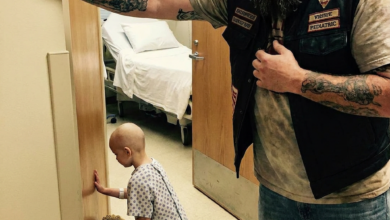
Part 2: Everyone Thought the Giant Tattooed Biker Had Attacked a Little Girl at Her Birthday Party — Then Her Mother Saw What Was Hidden in Her Wet Hair
Part 2 — The Giant at the Window
My name is Cara Mitchell, and the first time I saw Jonah Rourke, I counted the exits.
There were three: the main diner entrance, the kitchen door, and an emergency door beside the room where we had arranged Lucy’s birthday cake.
I was thirty-one, recently divorced, and accustomed to noticing ways out of places. My ex-husband, Travis, had never struck me, but he could turn a normal conversation into a room where every door seemed too far away.
After the divorce, I promised myself I would never again ignore the feeling that someone was dangerous.
The problem was that fear recognizes shapes faster than character.
Jonah had the shape.
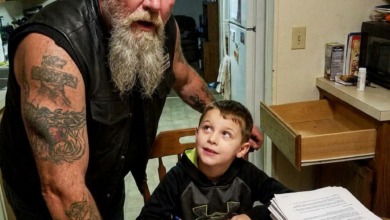
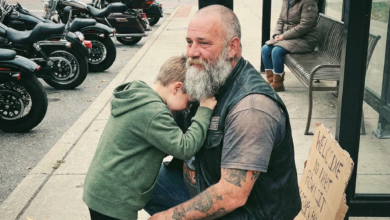
He entered Miller’s Roadhouse wearing a black leather cut, faded jeans, heavy boots, and a charcoal work shirt pulled tight across his shoulders. Black and blue ink covered both arms. A faded scar crossed one eyebrow, and his beard made the lower half of his face difficult to read.
His club called him Bear.
He looked more like a wall.
Lucy sat on my lap while the bikers settled near the windows. She had refused to nap, the diner was crowded, and the decorations kept falling because the tape would not hold against the wood paneling.
I was already close to tears before anything happened.
My sister Megan had ordered the cake. My mother brought balloons. My brother Kyle arrived late with his two boys, who immediately began chasing each other between the tables.
I wanted one clean photograph of Lucy smiling.
That seemed possible.
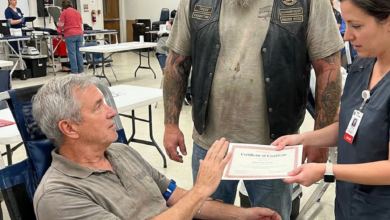
Jonah’s club had chosen Miller’s because one of their members, Marcus “Doc” Hayes, was retiring after twenty-seven years as a paramedic. The Black River Riders planned to give him a framed map marked with every county where he had answered emergency calls.
They were not supposed to overlap with our party.
The reservation book had been changed by a new hostess.
When Jonah noticed Lucy flinch at their laughter, he lowered his own voice and asked the others to do the same. I heard him but did not interpret it as kindness. I thought he was trying not to draw attention.
Lucy stared at his tattoos.
One showed a black river curling around his forearm. Another was a small red fire engine beneath his left elbow. Above it was a date I could not read.
Later, I would learn he kept that tattoo covered whenever possible.
Miller’s owner, Frank Delaney, knew Jonah. Frank had once been a prospect with the Black River Riders but quit riding after a knee injury.
“Bear looks rough,” Frank told me when he noticed my concern, “but he’s fixed half the school buses in Greene County.”
I smiled politely.
Jonah owned Rourke Diesel & Frame, a repair shop on West Chestnut Expressway. He worked on truck frames, motorcycles, farm equipment, and old machinery that dealerships no longer wanted to touch.
He could identify overheated brake pads from their smell.
He could hear a failing bearing beneath the rumble of an engine.
Metal, heat, oil, and combustion were the languages he trusted because none of them cared what he looked like.
People were more complicated.
Jonah’s record included a conviction for assault from eighteen years earlier. The story circulating online after Lucy’s birthday would treat that fact as proof he had always been dangerous.
The court file did not mention the beginning clearly.
His younger brother, Daniel, had been drunk and angry outside a convenience store. Daniel shoved his girlfriend into a car. Jonah pulled him away. Daniel swung first. Jonah swung last.
The final punch fractured Daniel’s jaw.
Jonah pleaded guilty rather than ask Daniel’s girlfriend to testify while she was trying to leave the relationship. He served fourteen months and lost his position as a volunteer firefighter.
The Black River Riders were among the few people who stayed.
Doc visited every other Thursday.
Calvin “Switch” Moore stored Jonah’s motorcycle while he was incarcerated. Club president Amos Reed kept Jonah’s repair tools from being sold to cover legal bills.
Jonah repaid them through years of quiet work.
He rebuilt Doc’s engine after a stroke left him unable to pay. He replaced the roof on Amos’s mother’s house. He carried jumper cables, trauma dressings, drinking water, and a compact fire blanket in his Harley’s saddlebag.
The blanket was not club equipment.
It had belonged to Daniel’s daughter, Emily.
Five years after Jonah left prison, Daniel fell asleep while smoking in an apartment living room. A curtain caught fire. Daniel escaped through the front door.
Four-year-old Emily did not.
Jonah entered through a window before firefighters arrived. He reached her bedroom, but smoke pushed him back. The burns on his left shoulder came from that attempt.
The little red fire-engine tattoo carried Emily’s birthday.
Jonah stopped speaking to Daniel after the funeral. He also stopped celebrating his own birthday.
Yet he carried a photograph of Emily beside a purple cake, laughing with frosting on her nose. The fire blanket in his saddlebag was the replacement he bought after learning that the original blanket in Daniel’s kitchen had still been sealed in its package.
Jonah never told that story to strangers.
He did not use grief as identification.
The club knew enough not to ask.
On Lucy’s birthday, Jonah had placed two bottles of water on the table because July heat pushed the diner’s air conditioner beyond its strength. One bottle was sealed. Doc had opened the other, taken a drink, and left it near the aisle.
That open bottle mattered.
So did the chair Jonah selected.
He sat facing our party.
Not because he was watching Lucy.
Because former firefighters often sat where they could see the room.
The birthday candles arrived shortly after two. They were taller than ordinary candles, thin and curved, each with a sparkling coating that produced a brighter flame.
Frank had purchased them online.
The package called them premium celebration candles.
It did not say they were intended for children.
Lucy leaned toward them while I held the cake steady. A strand of ribbon brushed one flame, but the flame did not remain on the ribbon. It entered the loose outer layer of her bun, fed briefly on hair spray, and curled inward where none of us could see it.
There was no dramatic burst.
No visible blaze.
Only a small orange line folding itself beneath blond hair.
Then everyone crowded closer.
Everyone except Jonah.
He leaned back.
His expression changed.
And he breathed in once.
Part 3 — Four Seconds Without the Truth
Jonah’s chair fell before the smell reached anyone else.
He crossed fifteen feet in perhaps two seconds. Doc later said Bear moved faster than he had seen him move in twenty years.
Jonah did not explain.
There was no time.
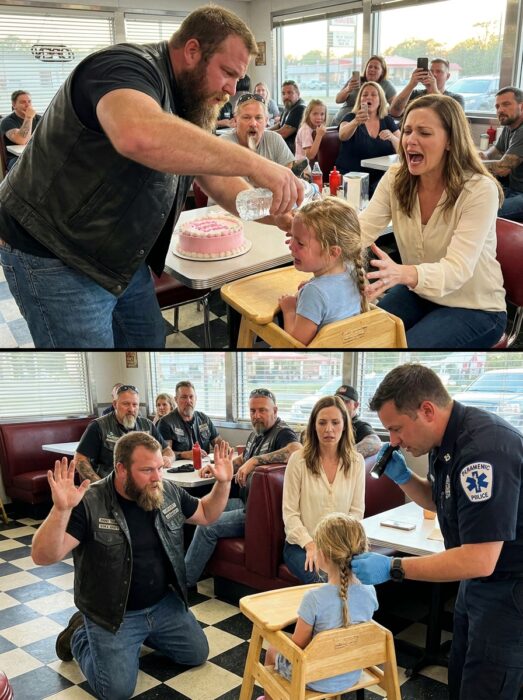
He took the open bottle from Kyle’s hand and poured it over Lucy.
My daughter screamed.
I remember water splashing across the cake, the paper tablecloth collapsing beneath it, and Jonah’s enormous hand above Lucy’s head. I remember his beard, his tattoos, and the fact that he had acted without asking me.
I do not remember deciding to strike him.
My fist hit the left side of his chest. Pain traveled through my wrist.
He did not move.
The second punch caught his mouth because I reached higher. My wedding ring, which I still wore on my right hand because I had not decided what else to do with it, split the inside of his lip.
Jonah let me hit him.
Kyle grabbed the back of his vest. Megan pulled Lucy from the high chair. My mother screamed for someone to call the police.
The Black River Riders stood.
Twelve chairs scraped backward.
Every sound sharpened.
Amos Reed took one step toward Jonah. Switch began moving toward Kyle.
Jonah spoke without turning around.
“Sit down.”
The riders stopped.
That single command prevented the room from becoming something worse. Kyle released Jonah’s vest when he realized no one was coming to fight him.
Jonah raised both hands and watched Lucy.
“Keep her still.”
“Stay away from her!” I shouted.
“Check the bun.”
I thought he was trying to distract us from what he had done.
Then Doc moved beside Lucy. His retired-paramedic instincts returned before anyone finished explaining. He lowered his face near the wet braid and smelled the air.
“Burned hair.”
The words changed the room.
Doc asked Megan not to remove the ribbon until he checked for heat. Jonah passed him another bottle, still sealed. Doc poured a small amount over the back of the bun, then separated the ribbon carefully.
Several strands had curled into black hooks.
A narrow patch of hair had burned approximately an inch from Lucy’s scalp. The flame never reached her skin.
Lucy was frightened, soaked, and furious about her dress.
She was not injured.
Doc examined her scalp beneath the diner’s kitchen light. No redness. No blistering. No tenderness beyond the discomfort of adults touching her hair.
Someone called 911 anyway.
Jonah pressed a paper napkin against his mouth. A red mark spread through it.
I stood three feet away, unable to find a sentence large enough to cross the space between us.
“I hit you.”
He shrugged once.
“My daughter—”
“She’s okay.”
“I didn’t know.”
“You weren’t supposed to. You were watching her face.”
His answer contained no accusation.
That made it worse.
Frank arrived from the kitchen demanding to know what had happened. Before Doc could explain, a college student named Brandon Keene pushed through the crowd holding his phone.
Brandon was Frank’s twenty-year-old nephew. He worked weekends at the diner, mostly carrying dishes and managing its social-media accounts.
“I got the whole thing,” he said.
He did not.
Or rather, the video he showed Frank was not the whole thing.
It began half a second before Jonah poured the water. The frame centered on Jonah’s tattooed arm, Lucy’s small head, and my horrified face.
It captured my screams.
It captured both punches.
It captured Jonah standing over us.
It ended before Doc opened the bun.
Frank saw a liability problem before he saw anything else. Families around the room were already demanding that the bikers leave.
“You need to go, Bear.”
Doc stared at him.
“He stopped a fire.”
“I don’t care what you think happened. Look at this room.”
Jonah looked at Lucy.
She had stopped crying and was touching the wet end of her ribbon.
Then he looked at me.
“Want me gone?”
The decision should not have belonged to me. I was still shaking, still trying to place the last minute into an order my mind could accept.
I nodded.
Jonah picked up his fallen chair, placed it beneath the table, and walked outside.
The Black River Riders followed.
Doc remained long enough to speak with the ambulance crew.
He told them exactly what happened.
Paramedic assessment confirmed no burn injury. They recommended washing the hair and monitoring the scalp. Lucy refused the small stuffed bear they offered because it was “not her birthday bear.”
Outside, twelve motorcycles started.
Jonah did not leave immediately. Through the window, I saw him standing beside his Harley with a bloodied napkin against his mouth.
Amos spoke to him. Jonah shook his head.
The club rode away without confrontation.
At 2:19 p.m., Brandon uploaded the four-second video.
His original caption read:
Biker dumps water on crying toddler at Springfield restaurant. Mother fights back.
The clip spread before the ambulance left.
By three o’clock, it had more than 80,000 views.
By dinner, other accounts had copied it, slowed it down, zoomed in on Jonah’s tattoos, and added invented details.
They said he was drunk.
He had consumed coffee.
They said the club had threatened the family.
The riders had obeyed Jonah and left.
They said Lucy suffered chemical burns.
She was eating macaroni while I washed hair spray and soot from her bun.
Someone identified Jonah through his shop logo visible on a truck outside the diner. Another person found his old conviction.
The comments became punishment.
People called his repair shop and threatened to burn it. They posted photographs of his employees. They left messages accusing the Black River Riders of attacking children.
Someone found Emily’s photograph on a memorial page and claimed she was another child Jonah had harmed.
That lie reached him before the truth did.
Amos called an emergency club meeting. Several riders wanted to post Brandon’s address, expose Frank’s business records, and send members back to Miller’s in formation.
Jonah refused.
“No families. No threats. No rides past the diner.”
“They’re calling you a child abuser,” Switch said.
“Then don’t act like what they already decided we are.”
The club argued.
Jonah removed his cut and placed it on the table.
“If anyone goes after that family, do it without this.”
Brotherhood had been tested by fists before.
This time it was tested by humiliation.
Anger would have felt like loyalty.
Restraint required more.
Meanwhile, I recorded a video explaining that Jonah had saved Lucy from a hidden flame. My hands shook so hard that I restarted six times.
Before I posted it, Jonah called.
Frank had given him my number.
“Don’t show her face,” he said.
“The entire internet thinks you attacked her.”
“She’s three.”
“This could clear you.”
“It follows her forever.”
“They’re threatening your shop.”
“Then talk without her.”
I looked across my living room. Lucy slept on the couch with damp hair spread across a towel, one hand still clutching a piece of birthday ribbon.
Jonah was protecting her privacy while strangers used her screams to destroy him.
I posted a statement without Lucy’s image.
Many people called me a liar.
They said the mother in the video was clearly terrified of Jonah.
They were right.
For four seconds, I had been.
Brandon told Frank he no longer had the original recording. He claimed his phone had automatically deleted it after uploading.
That was another lie.
A sixteen-year-old dishwasher named Mateo Alvarez had watched Brandon edit the clip in the supply hallway.
Mateo had also recorded the birthday song from behind the dessert counter.
His video began forty-three seconds earlier.
And it showed everything.
Part 4 — What the Full Video Held
Mateo came to my apartment the following morning with his father.
He was a quiet Latino teenager with thick black hair, a Miller’s Roadhouse cap, and the rigid posture of someone expecting punishment.
His father, Luis, worked nights at a packaging plant. He apologized before Mateo even sat down.
“My son recorded your child without asking.”
Mateo placed his phone on the table.
“I was filming the candles because Brandon wanted clips for the diner page,” he said. “Then I forgot to stop.”
The video began with Lucy clapping while everyone sang. Jonah appeared in the background near the windows, seated with the bikers.
At first, nothing looked unusual.
Then Mateo slowed the final seconds.
Lucy leaned forward.
The ribbon touched the middle candle.
A tiny orange glow entered her bun.
It disappeared when she pulled away.
Everyone applauded.
Jonah’s head turned.
He stood.
The audio captured his first words, nearly buried beneath our cheering.
“Her hair.”
He moved before the flame became visible again. The water struck Lucy’s bun. A small puff of gray smoke rose through it.
Then I hit him.
Mateo’s recording continued for another three minutes. It showed Doc finding the singed strands. It showed the paramedics confirming that Lucy’s scalp was uninjured. It showed Jonah refusing to argue with Frank.
It also captured Brandon speaking near the supply hallway.
“If I cut it before the smoke, this thing will explode online.”
A female server asked whether that would make the diner look responsible.
Brandon answered, “It makes the biker look responsible.”
Frank heard the full recording in my living room.
His face lost color.
Brandon had uploaded the clip partly for attention and partly to move blame away from Miller’s use of the tall decorative candles. Frank’s business insurance had warned him months earlier that open flames required safer placement around children.
The diner had continued using them because the sparkling coating looked good in birthday photographs.
Brandon knew a full video could raise questions about the candles, crowded table, and lack of distance between the cake and Lucy’s hair.
A terrifying biker offered a simpler story.
Frank called his nephew from my kitchen.
Brandon denied everything until Frank played the audio. Then he said he had never expected the clip to spread beyond the diner’s page.
He insisted Jonah could handle the attention.
“He’s a biker,” Brandon said. “People already think they’re dangerous.”
That sentence carried the entire decision.
Jonah’s appearance had been treated as consent.
Because people already feared him, Brandon decided another lie would not cost much.
Frank fired him.
That did nothing to remove the copied videos.
We met Jonah at Rourke Diesel & Frame that afternoon. The shop’s front window had been spray-painted with the word MONSTER. A brick had broken the lower pane.
Two employees swept glass from the waiting area.
Jonah stood beneath a truck lift welding a bracket. Sparks fell around his boots. He finished the bead before removing his helmet.
His split lip had swollen overnight.
When he saw Mateo, he looked toward the teenager’s work cap.
“You’re Frank’s dishwasher.”
Mateo nodded.
“Good fries.”
Mateo nearly smiled.
We showed Jonah the video.
He watched without speaking. When Emily’s name appeared among screenshots of the online threats, he turned the phone facedown.
Amos wanted to release everything immediately.
Jonah objected to Lucy’s face appearing.
“We can blur her,” Mateo said.
“And her voice?”
“We can change it.”
“Her name’s already out there.”
I stepped closer.
“Jonah, let us correct this.”
He looked at the broken shop window.
“Correction doesn’t catch a lie. It walks behind it.”
“Then it still needs to walk.”
We agreed to release a redacted version through a local television reporter, Naomi Brooks, who verified the original file metadata. Lucy’s face was blurred. Her name was withheld. The audio included Jonah identifying the danger and Brandon discussing the edit afterward.
The report aired that evening.
The public reaction reversed almost as violently as it had begun.
People praised Jonah as a hero.
They filled his shop’s voicemail with apologies. Parents mailed water bottles, fire blankets, and cards. Strangers arrived asking for photographs beside his motorcycle.
Jonah disliked this version almost as much.
“I poured water,” he told Naomi. “That’s not hero work.”
Naomi asked why he allowed me to punch him.
Jonah looked toward the floor.
“She thought I was hurting her kid.”
“Why didn’t you restrain her?”
“Would’ve taken my eyes off the kid.”
“What went through your mind?”
“Make sure it’s out.”
Naomi asked about Emily.
The room changed.
Jonah removed his microphone.
“That part’s not yours.”
The interview ended.
The station respected the boundary, but the internet did not. Other accounts copied Emily’s memorial photograph and attached it to Jonah’s rescue, turning a dead child into a dramatic explanation he had never offered.
Daniel Rourke saw those posts.
Jonah had not spoken to his brother in fourteen years.
Daniel arrived at the shop the following morning.
He looked nothing like Jonah. He was thin, clean-shaven, and dressed in the khaki uniform of a commercial laundry service. Age had sharpened his cheekbones.
He held the printed photograph that people had taken from Emily’s memorial page.
“You carry this?”
Jonah said nothing.
Daniel’s eyes moved toward the saddlebag.
“You keep using her.”
The accusation struck harder than my fists had.
Amos stepped forward. Jonah stopped him with one hand.
“I never posted her.”
“People are saying you saved that girl because you couldn’t save mine.”
“I told them nothing.”
“You get to be the hero now?”
Jonah’s face remained still, but his fingers tightened around the edge of the workbench.
“No.”
Daniel tore the photograph in half.
Calvin Switch moved before anyone else, catching Daniel’s wrist.
Jonah shoved Switch away.
“Let him go.”
Daniel left the pieces on the floor and walked out.
Jonah waited until the door closed, then knelt and collected both halves.
He did not tape them together.
He returned them to his saddlebag separately.
That evening, he told the club he would step away until attention faded. He believed his presence had become a risk to the shop and the Riders.
Amos disagreed.
“You kept us from making it worse.”
“Still brought it to your doors.”
“Brother, somebody else brought the lie.”
Jonah looked at the cuts hanging along the meeting-room wall.
“I gave it a face.”
Amos picked up Jonah’s vest and held it out.
“No. They borrowed yours.”
Jonah took it.
The distinction mattered.
Part 5 — The Mother Who Hit Him
I returned to Miller’s Roadhouse one week later.
The birthday decorations were gone. The private room smelled of coffee and disinfectant. Frank had removed every decorative candle from the building and hired a fire-safety consultant to retrain employees.
He offered me free meals for a year.
I declined.
What I wanted could not be served on a plate.
I asked to see the table where Lucy had sat. Beneath the edge, someone had missed a faint black mark where a wet piece of singed ribbon touched the wood.
I rubbed it with my thumb.
The mark remained.
For several nights, I replayed the moment before Jonah moved. I watched myself adjust Lucy’s paper crown. Megan reached toward the cake. Kyle laughed behind the camera.
Sixteen adults stood within ten feet of my daughter.
Only Jonah noticed.
That fact initially made me feel like a bad mother.
During our second conversation, Jonah refused to let me keep that guilt.
“You were looking at her eyes,” he said. “I was looking across the room.”
“I should have seen it.”
“You saw what mothers watch.”
“What’s that?”
“Whether she was scared.”
He spoke as if the answer were obvious.
I asked whether my punches hurt.
“The ring had opinions.”
“I’m sorry.”
“I know.”
“I need you to say you forgive me.”
Jonah looked uncomfortable.
“Why?”
“So I can stop hearing them.”
“Then you’re asking me to fix your part.”
The words were not cruel.
They were accurate.
My apology needed to exist even if it did not produce relief.
“I attacked you because I judged what I saw before I understood it.”
“You attacked me because a stranger dumped water on your kid.”
“I called you a monster after you saved her.”
“That part was judgment.”
He let the silence sit.
Then he added, “Work on that part.”
I did.
Naomi Brooks invited us to participate in a longer report about misleading viral clips. Jonah agreed only after the station promised not to show Lucy or discuss Emily.
I sat beneath studio lights and admitted that the cropped video had captured a genuine emotion but removed the reason for it. My fear was real.
The story built around it was false.
A four-second clip did not need fabricated pixels to lie. It needed only a missing fifth second.
Mateo joined the report. He explained how easily Brandon removed context and how recommendation systems rewarded anger before verification.
Frank acknowledged the diner’s unsafe candle choice.
Jonah spoke last.
Naomi asked what people should do when they see a shocking video.
“Wait for the room,” he said.
“What does that mean?”
“Four seconds shows a hand. The room tells you why it moved.”
It was the longest answer he gave.
The civil damage from Brandon’s post continued. Jonah’s shop lost two commercial accounts before the full video aired. Both companies returned later, but one purchasing manager asked for a discount as a condition.
Jonah refused.
The shop window cost $1,800 to replace. The man who threw the brick was identified through traffic cameras. He was a forty-two-year-old father who told police he believed he was protecting children.
Jonah declined to request jail.
He asked for restitution and community service.
“Let him replace the glass,” Jonah told the prosecutor. “Slow enough to look through it.”
The man arrived at the shop on a Saturday morning. Jonah handed him gloves, safety glasses, a scraper, and a broom.
They worked without speaking for two hours.
When the new pane was installed, Jonah pointed toward a small bubble trapped near one corner.
“Glass lies too,” he said. “Just less often than people.”
The man apologized.
Jonah nodded and returned to work.
Brandon’s consequences were more complicated. Frank fired him, but anger online quickly turned toward Brandon’s family. Strangers posted his parents’ address and threatened the diner.
Jonah publicly asked people to stop.
“What he did was wrong,” he wrote through the club’s page. “Threatening his mother will not make it right.”
Brandon eventually contacted Jonah through Naomi.
He wanted to apologize on camera.
Jonah refused the camera.
They met privately in the diner before opening. I attended because Brandon requested it.
He looked younger without his phone raised.
“I wanted the page to grow,” he said. “Videos with conflict get views.”
“You saw her hair,” Jonah replied.
“I saw smoke after you poured the water.”
“And you cut it.”
Brandon nodded.
“Why?”
“Because once the smoke was there, you weren’t the villain.”
Jonah leaned back.
“You needed one?”
“The video did.”
“No. You did.”
Brandon began crying. Jonah did not comfort him, but he did not leave.
He asked Brandon to pay for half the shop window through work, even though Brandon had not thrown the brick.
“You broke the view,” Jonah said. “Help replace it.”
For ten Saturdays, Brandon cleaned the shop, organized parts, and answered phones. Jonah paid him minimum wage, then deducted an agreed portion toward the glass.
The first time an angry caller asked for “the biker who attacked that baby,” Brandon did not hang up.
He explained the entire sequence.
Slowly.
When he finished, Jonah placed a broom in his hands.
“Again next time.”
Part 6 — The Birthday Ride
A year passed.
Lucy’s hair grew beyond the small section we had trimmed. She remembered the wet cake more clearly than the fire.
Whenever she saw Jonah, she called him Mister Giant.
He pretended to dislike it.
For her fourth birthday, I asked what kind of party she wanted.
“Motorcycles,” she said.
I tried three times to change her mind.
She wanted motorcycles.
The Black River Riders held the celebration in the parking lot behind Rourke Diesel & Frame. There were no candles. Frank provided cupcakes with small paper pinwheels instead.
Jonah inspected those too.
Lucy wore a yellow helmet and sat on a stationary Harley while twelve bikers formed a patient line to let children press horns, touch cool handlebars, and ask why motorcycles had so many shiny pieces.
Amos wore a pink paper crown.
Switch allowed Lucy to cover one forearm tattoo with temporary butterfly stickers.
Doc demonstrated how to cool a minor burn with clean running water and when to call emergency services. He made clear that water bottles were not a substitute for proper first aid, except when immediate action was needed to stop something actively burning.
Parents listened.
So did the bikers.
Jonah kept the fire blanket on a table beside the first-aid kit. For the first time, he removed Emily’s photograph from his saddlebag and placed it inside a small wooden frame near the blanket.
No sign explained her.
None was needed.
Daniel arrived near the end of the party.
He stood beyond the motorcycles holding a roll of clear archival tape and a new copy of Emily’s photograph. He had found the original digital file through his former wife.
Jonah saw him.
Neither man moved for several seconds.
Then Daniel crossed the parking lot and placed the photograph beside the torn pieces Jonah still carried.
“I was angry she became part of another story,” Daniel said.
“She didn’t.”
“I know.”
Jonah looked toward Lucy, who was fastening butterfly stickers to Amos’s beard.
Daniel swallowed.
“You smelled the hair because of that night?”
“Partly.”
“I smelled smoke too.”
“Too late.”
Daniel lowered his eyes.
Jonah could have agreed.
He did not.
“We both got there too late.”
It was not absolution. It was shared ownership of something neither man could change.
Daniel helped tape the torn photograph from behind, leaving the break visible. Jonah returned it to the frame.
They did not embrace.
Daniel stayed for a cupcake.
For Jonah and his brother, that was enough for one day.
As sunset approached, Lucy handed Jonah a sealed water bottle decorated with pink stickers.
“For emergencies,” she said.
Jonah placed it inside his saddlebag beside the fire blanket.
“Good gear.”
She pointed toward his lower lip.
“Did Mommy bonk you?”
I covered my face.
Jonah considered the question.
“Your mom had fast hands.”
“Did you cry?”
“No.”
“Mommy did.”
Jonah looked at me.
“I know.”
Part 7 — What I Smelled First
Two years after the diner incident, the original cropped video still appeared online occasionally.
New accounts reposted it without the correction. Each time, strangers rediscovered four seconds of fear and behaved as though the following minutes had never existed.
I stopped trying to answer everyone.
Instead, I kept Mateo’s full recording.
Not because I wanted to watch Lucy nearly get hurt, but because it reminded me how easily a truth could be cut at the precise frame where understanding began.
Miller’s Roadhouse placed flameless candles in birthday desserts. Frank kept one scorched decorative candle in his office as a warning to new employees.
Mateo graduated and entered a fire-protection engineering program.
Brandon completed his work at Jonah’s shop but continued visiting on Saturdays. Jonah taught him basic welding and refused to call the instruction forgiveness.
“Just keeping his hands busy,” he said.
The Black River Riders began carrying compact fire blankets and first-aid kits during group rides. They partnered with Doc to offer short emergency-response sessions for local clubs.
Jonah never called himself a hero.
Whenever someone used the word, he changed the subject or found something mechanical to inspect.
One summer evening, Lucy and I visited his shop after closing. She sat on the workbench drawing pink flames on a cardboard motorcycle while Jonah cleaned grease from his hands.
I asked him what he remembered most from her birthday.
“The smell.”
“Not me punching you?”
“Close second.”
I laughed.
Then I asked the question that had remained with me.
“Why didn’t you stop me?”
He folded the shop towel once.
“You thought I hurt her.”
“You could’ve blocked me.”
“Could’ve.”
“Why didn’t you?”
He looked toward Lucy.
“Needed to see if the smoke stopped.”
The answer had not changed.
Neither had he.
When we left, Jonah walked us to the car. The evening air smelled of hot pavement, gasoline, and cut grass. His Harley stood beside the garage with Lucy’s sticker-covered water bottle secured inside the open saddlebag.
She hugged one of his tattooed legs.
Jonah rested a huge hand lightly on her hair.
No flames.
No smoke.
Only a pink ribbon shifting beneath his fingers.
He closed the saddlebag, started the Harley, and waited until our car pulled safely onto the road before following.
The V-twin rumbled behind us through the gathering dark.
This time, I did not look for an exit.
Follow our page for more biker stories about misunderstood actions, quiet courage, and rough-looking strangers who notice the danger everyone else misses.