Part 2: A 6’4 Tattooed Biker Stood Outside His Daughter’s High School for Nine Hours Holding One Sign — And the Moment She Finally Walked Out Broke Everyone Watching
Part 2
My anxiety did not begin with the graduation examination.
It had been living quietly inside me for years, changing shape whenever adults believed I had finally outgrown it.
After my mother died, I began checking the front-door lock five times before bed. I counted Dad’s breaths when he slept in the recliner and panicked whenever his motorcycle was ten minutes late returning home.
At thirteen, I stopped raising my hand in class because the possibility of giving a wrong answer felt more dangerous than remaining invisible.
At fifteen, I abandoned the school choir moments before our first performance. I had memorized every song, but when the auditorium filled, my hands went numb and the stage seemed to tilt beneath me.
People called me shy.
Teachers said I lacked confidence.
One counselor told Dad I needed to learn resilience.
He listened without speaking, then asked whether resilience came in a bottle because he would purchase two.
The counselor did not laugh.
Dad learned slowly that anxiety was not simply nervousness. It was an alarm system that could no longer distinguish smoke from sunlight.
He took me to therapy even when insurance covered only part of the cost. He waited outside every appointment in his leather vest, drinking terrible vending-machine coffee and pretending not to watch the clock.
He learned breathing exercises.
He placed a small card inside my backpack listing five things to identify during panic: something visible, something touchable, something audible, something scented, and something real.
At the bottom, in his rough handwriting, he added:
Something real: Dad comes back.
That sentence helped until my senior year, when graduation transformed from a distant possibility into a deadline.
Our school required every senior to complete a final comprehensive examination and oral presentation connected to a yearlong research project. Students who failed received another opportunity during summer, but they could not walk at graduation with their class.
My project examined how motorcycle clubs had helped rebuild rural communities after tornadoes and floods.
Dad assumed I chose the subject because of him.
I told him bikers were simply easy to interview.
Both things were true.
I had completed the research, written the paper, and practiced the presentation in our living room until Dad could repeat entire paragraphs. My teachers believed I was prepared.
Anxiety kept presenting different evidence.
What if I forgot everything?
What if my voice disappeared?
What if the examiners looked at me and saw a girl pretending to be capable?
My English teacher, Mrs. Elena Alvarez, understood more than most. She was a forty-seven-year-old Mexican American woman who had experienced panic attacks during graduate school and recognized the signs before I spoke about them.
She arranged for me to take the written sections in a smaller classroom with six other students. She placed my desk near a window, believing natural light might make the space feel less closed.
Neither of us knew that window would face the front gate.
The evening before the examination, Mrs. Alvarez called Dad after I emailed her to say I might not attend.
Dad rarely answered unfamiliar numbers.
He answered hers.
“She believes failure would mean she does not deserve graduation,” Mrs. Alvarez explained.
“What am I supposed to say to that?”
“Tell her the examination measures her work, not her worth.”
Dad was silent.
“Mr. Harrison?”
“I can’t make those sound like different things to her.”
“No. But you can remind her that one difficult day does not change what you already know.”
“What do I know?”
Mrs. Alvarez paused.
“That you are proud of her before you know the result.”
Dad wrote the sentence down on the back of an electrical bill.
He shortened it because cardboard did not need an essay.
The result was five words.
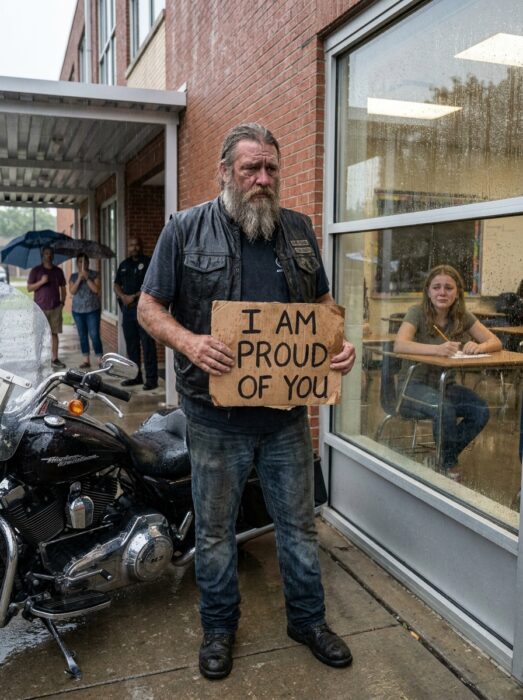
I AM PROUD OF YOU.
Part 3
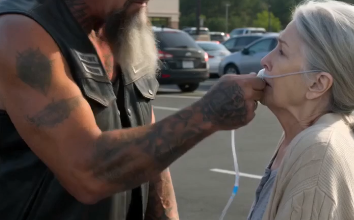
Dad arrived at Westfield High School before the custodians unlocked the side entrance.
The campus security officer, Daniel Brooks, saw the motorcycle first. A black Harley idling near a school gate at seven in the morning naturally attracted attention.
Then Brooks saw the man carrying a large cardboard sign.
“Sir, demonstrations are not permitted on school grounds without approval.”
Dad looked at the sign.
“I’m not demonstrating.”
“What would you call this?”
“Parenting badly but enthusiastically.”
Brooks examined the words.
“Are you protesting something?”
“My daughter thinks she doesn’t deserve to graduate.”
“That doesn’t answer my question.”
“I’m protesting that.”
The public sidewalk remained outside school property, so Brooks told Dad he could stand there as long as he did not obstruct pedestrians, approach students, or create a disturbance.
Dad agreed.
Then he stayed.
At first, students believed the sign was intended for everyone. Several seniors photographed him and posted the image online.
Random biker thinks we’re all doing great.
Others joked that the school had hired an unusually threatening motivational speaker.
Dad ignored them.
At 7:54, Mrs. Alvarez entered the classroom and noticed him through the window.
She immediately understood.
When I arrived, my hands were already trembling. I sat at the desk nearest the door because part of me wanted the quickest escape route.
Mrs. Alvarez quietly moved my assigned materials to the desk near the window.
“You said enclosed rooms make it worse,” she explained.
I sat.
Then I saw Dad.
He stood beyond the gate, holding the sign at chest height.
The embarrassment arrived first.
Two students whispered and looked toward me. One recognized the motorcycle-club patch.
“Is that your dad?”
I considered lying.
Mrs. Alvarez answered for me.
“That is a father who appears to understand his assignment.”
The first written section began at eight-thirty. I read the opening question six times without understanding it.
My heartbeat became louder than the room.
Then I looked outside.
Dad raised the sign slightly.
He could not see my face through the reflective window, but somehow he knew when I was watching.
I placed both feet flat against the floor.
Something visible: the black letters.
Something touchable: the edge of my desk.
Something audible: pencils moving across paper.
Something scented: Mrs. Alvarez’s coffee.
Something real:
Dad was still there.
I answered the first question.
Outside, the temperature climbed into the upper eighties. Dad had expected shade from a nearby tree, but the angle of the morning sun left him exposed.
At nine-thirty, Deacon from the Black River Riders arrived with coffee and a folding chair.
Dad accepted the coffee.
He refused the chair.
“You can sit and hold a sign,” Deacon said.
“Window’s too high.”
“You’re going to hurt tomorrow.”
“I’ll schedule that.”
Deacon glanced toward the school.
“She see you?”
“I hope so.”
“What if she’s in a different room?”
Dad looked at him.
“Then I’m an idiot standing beside a school.”
“You have previous experience.”
Deacon left him a bottle of water and returned to work.
At ten-fifteen, Principal James Holloway received three complaints. One parent said the biker’s presence was distracting. Another claimed the sign might be connected to a political protest.
Holloway walked outside.
He was fifty-five, neatly dressed, and uncomfortable with situations that could not be resolved through policy language.
“Mr. Harrison, we appreciate parental encouragement, but students are taking photographs.”
“I noticed.”
“It may be disrupting the examination environment.”
Dad looked through the windows.
“Is my daughter taking the test?”
“I cannot discuss individual students.”
“Then I cannot discuss individual sidewalks.”
Holloway’s expression hardened.
Brooks moved closer.
Dad did not threaten anyone. He did not raise his voice or step onto school property.
He simply held the sign.
The principal could not legally remove him from a public sidewalk without a valid reason, but he could close the classroom blinds.
He returned inside intending to do exactly that.
Mrs. Alvarez stopped him in the hallway.
“If you close that blind, Ava may not finish today.”
Holloway looked toward me.
I had completed two sections.
My hands were steady.
Every few minutes, my eyes moved toward the gate.
“What is he doing?” Holloway asked.
Mrs. Alvarez watched Dad raise the sign again.
“He is lending her his nervous system.”
The principal frowned.
“She is looking outside, seeing that he has not left, and using the repetition to regulate herself.”
“Is that allowed?”
“Nothing in the rules prohibits a student from having a father.”
The blinds remained open.
Part 4
At noon, clouds moved across the campus.
Dad had been standing for five hours.
The painted letters began leaving black marks on his fingers, and the cardboard softened where sweat from his palms reached the edges.
A cafeteria employee brought him a sandwich.
He attempted to pay.
She refused.
“My father never came to anything,” she said. “Let me buy lunch for one who stays too long.”
Dad placed the sandwich on his motorcycle seat. He could not eat while holding the sign, and setting it down felt like breaking the message.
Brooks offered to hold it.
Dad hesitated.
“You’re still here,” Brooks said. “She’ll know.”
For three minutes, the security officer held the sign while Dad ate half the sandwich and stretched his shoulders.
Students watching from the cafeteria windows began cheering.
Brooks immediately returned the cardboard.
“I’m not becoming part of this.”
“You already are.”
At 12:40, the written examination ended. The oral presentations would begin after a short break.
I went to the restroom and discovered a group of students discussing Dad.
One said the gesture was sweet.
Another called it excessive.
A third said her own parents had forgotten the examination date.
I locked myself inside a stall and began crying.
Not from fear.
From the realization that Dad was still out there while I had spent years believing my anxiety exhausted everyone who loved me.
Mrs. Alvarez found me after ten minutes.
“I can’t present,” I told her.
“You completed the written section.”
“That was different.”
“Yes.”
“What if I freeze?”
“Then you pause.”
“What if they think I’m stupid?”
“They have read your research.”
“What if I fail anyway?”
Mrs. Alvarez sat on the other side of the locked stall door.
“Then your father will still be holding the same sign.”
That was the difference.
The words did not say:
I will be proud if you pass.
They did not say:
Make me proud.
The statement was already complete.
I AM PROUD OF YOU.
No condition.
No score.
No future tense.
When my name was called, I entered the presentation room carrying my note cards. Three evaluators sat behind a long table. My project slides appeared on the wall.
Through a narrow side window, I could still see the gate.
Dad stood beside the Harley.
The first drop of rain struck his sign during my opening paragraph.
By the third slide, the rain had become steady. Parents beneath the school awning watched him from a distance, expecting him to move.
He did not.
Water darkened his leather vest. His beard flattened against his chest. The sign bent backward in the wind, and Dad reinforced the center with one tattooed forearm.
My evaluators began asking questions.
I answered the first.
Then the second.
The third concerned whether biker charity efforts sometimes became more about publicity than community needs.
Under different circumstances, the question might have felt like criticism of Dad.
Instead, I explained that effective service required listening before acting, accountability to local organizations, and a willingness to perform work that might never be photographed.
Outside, Dad stood in the rain where half the school could photograph him.
Yet he was not there for them.
He was there for one window.
My final statement discussed visible commitment—the difference between claiming loyalty and remaining when staying becomes uncomfortable.
One evaluator smiled.
“Did your research become personal?”
I looked toward the gate.
“Yes.”
The presentation ended at 2:17.
I had completed every requirement.
But results would not be released until later that afternoon, after all panels submitted their assessments.
I returned to the classroom and waited.
Dad remained outside.
Part 5
The final two hours were worse than the examination.
Anxiety thrives in unanswered spaces. I reviewed every mistake until each one became larger than everything I had done correctly.
At three o’clock, Mrs. Alvarez received an email.
She read it without changing her expression.
I assumed that meant failure.
“Please tell me.”
She turned the monitor toward me.
PASS — GRADUATION REQUIREMENT COMPLETED.
I stared at the words.
Then I asked her to refresh the page.
She did.
The result remained.
“You passed,” she said.
My classmates began clapping.
I could not move.
For months, I had imagined passing would feel like becoming a different person. Instead, I remained inside the same body with the same frightened thoughts.
The difference was that I had acted while they were present.
Mrs. Alvarez helped me gather my things.
“Your father is waiting.”
At 4:00, the final bell sounded.
Students poured through the main entrance. Several had been following Dad’s vigil online and stopped near the gate instead of leaving.
When I stepped outside, rain was still falling lightly.
Dad saw me.
He attempted to read the answer from my face.
I started running.
The sidewalk blurred.
The crowd disappeared.
I reached him, but my knees collapsed before I could speak. Dad dropped the sign and caught me beneath both arms.
The force nearly knocked him backward.
“I’m sorry,” I cried.
“For what?”
“For making you stand here.”
“You didn’t make me.”
“I passed.”
His entire body released one breath.
“I knew you would.”
“No, you didn’t.”
Dad looked down at me.
“You’re right.”
That honesty made me laugh through the tears.
He had not stood outside because he knew the result.
He stood because the result did not determine whether I deserved him there.
“I didn’t quit,” I said. “Every time I wanted to leave, I looked outside.”
Dad pulled me against his chest.
“You did that.”
“You were here.”
“You did the work.”
“But you didn’t leave.”
His chin rested on my head.
“That was my part.”
Teachers gathered beneath the awning. Principal Holloway stood beside Brooks, his tie loosened and his shoes wet from stepping onto the sidewalk.
Mrs. Alvarez approached us.
“She completed the strongest presentation in her group.”
Dad looked at me.
“See?”
I shook my head.
“No. You don’t get to pretend you knew.”
“Fair.”
The cardboard sign lay in a shallow stream beside the curb. Water had wrinkled its surface, and one corner had folded beneath itself.
I pulled away from Dad and picked it up.
The black paint had bled slightly.
The words remained readable.
I AM PROUD OF YOU.
“You can throw it away,” Dad said. “I’ll make another.”
I held it against my chest.
“No.”
“It’s ruined.”
“No, it isn’t.”
Dad had been standing for nine hours, but when we began walking toward the parking lot, I was the one carrying the sign.
He limped beside me.
Only then did I notice how swollen his hands were, how slowly he moved his shoulders, and how deeply the wet leather had rubbed against his neck.
“Does everything hurt?”
“Mostly the parts I own.”
“Why didn’t you sit?”
“You couldn’t see the chair from the window.”
That answer broke me again.
Part 6
The school posted a photograph later that evening.
It had been taken by the cafeteria employee during the heaviest rain. Dad stood alone beside the gate with the soaked sign pressed against his chest, while students watched from windows behind him.
The caption read:
Sometimes support is not a speech. Sometimes it is staying where someone can see you.
Dad disliked the attention.
He believed the photograph made his beard look thin.
The Black River Riders printed it and hung it inside their clubhouse anyway.
At graduation two weeks later, Dad wore a white shirt beneath his leather vest. Principal Holloway had reserved him a seat near the aisle, although Dad insisted he preferred standing in the back.
When my name was called, he rose before anyone else.
No cardboard sign this time.
He placed two fingers against his heart.
I repeated the gesture from the stage.
After the ceremony, Dad gave me a small wooden frame he had built in the garage. He had sanded the edges, stained them dark, and placed a sheet of clear acrylic across the front.
The ruined cardboard was mounted inside.
Every water stain remained.
Every bend.
Every fingerprint in black paint.
A brass plate beneath it read:
NINE HOURS. NO CONDITIONS.
I hung the frame in my college dormitory that fall.
My roommate asked whether Dad’s gesture had cured my anxiety.
It had not.
That is not how anxiety works.
I still experienced panic before examinations. I sometimes skipped social events because crowds overwhelmed me. During my sophomore year, I called Dad at two in the morning and told him I wanted to leave college.
He did not give a speech.
He asked whether the sign remained on the wall.
“Yes.”
“What does it say?”
“You know what it says.”
“Read it.”
I felt ridiculous.
“Dad.”
“Read the sign, Ava.”
I looked through the dark room at the warped cardboard.
“I am proud of you.”
“Again.”
“I am proud of you.”
“Whose voice?”
“Yours.”
“No.”
I understood.
“Mine.”
The sign had begun as his message.
Over time, it became a sentence I was learning to say to myself.
I stayed in college.
Not because I stopped feeling frightened.
Because fear no longer received the only vote.
Part 7
Nine years have passed since my father stood outside Westfield High School.
The sign now hangs in my office.
I became a school counselor, which still surprises the teenager who once hid inside bathroom stalls whenever attention became too heavy.
My work is mostly quiet. I help students create plans for difficult mornings, sit beside parents who do not understand why love cannot simply switch anxiety off, and remind teachers that a child avoiding work may actually be avoiding the terror of failing publicly.
I never tell students they have nothing to fear.
Fear is real even when its prediction is not.
I ask what might help them continue while fear remains.
Sometimes the answer is a quieter room.
Sometimes it is additional time.
Sometimes it is knowing someone will wait outside.
Dad is sixty-one now.
His beard has gone mostly white, and arthritis prevents him from standing comfortably for nine hours. He still rides, although he traded the old Harley for a touring motorcycle with better suspension.
He visits my office twice each year to speak with students in our vocational program. They are initially fascinated by the tattoos and disappointed when he spends most of his presentation discussing punctuality, safety equipment, and taxes.
One afternoon, he noticed the framed sign above my desk.
“You still have that ugly thing?”
“It matches the furniture.”
“You could replace the cardboard.”
“That would defeat the point.”
He looked closer at the water damage.
“I spelled everything right.”
“Five words. An impressive performance.”
Dad smiled.
Then he became quiet.
“I should’ve said it more.”
“You said it.”
“I stood there because I couldn’t find the right words.”
“You found five.”
“Maybe you needed more.”
I moved beside him.
“I needed to see you mean them.”
Dad touched the lower edge of the frame.
That was what he had given me.
Not perfect reassurance.
Not certainty that I would succeed.
Visible love.
A message that survived heat, embarrassment, aching shoulders, school security, nine hours of waiting, and enough rain to destroy the cardboard without destroying its meaning.
Last spring, one of my students, a seventeen-year-old named Caleb, prepared for the same graduation requirement I had once feared.
He had failed his first attempt and refused to return for the second.
“I’m already the stupid kid,” he told me. “Taking it again just gives everyone proof.”
His mother worked out of state and could not attend. His grandfather was recovering from surgery.
I asked whether anyone could wait nearby.
Caleb shook his head.
On the morning of the examination, I arrived before sunrise.
Dad was already outside the gate.
He held a new sign.
The letters were neater this time because I had painted them.
YOU DO NOT HAVE TO DO THIS ALONE.
Caleb saw him through the classroom window.
“Who is that?”
“My father.”
“Why is he here?”
“He has experience standing in inappropriate places.”
Caleb almost smiled.
Dad remained for three hours until the examination ended. He used a chair now and held an umbrella when the sky darkened.
Caleb passed.
When he came outside, he did not collapse into Dad’s arms. He offered an awkward handshake and stared at the sign.
“You don’t even know me,” he said.
Dad shook his hand.
“Didn’t know my daughter could pass either.”
Caleb looked confused.
“Then why did you stand there?”
Dad glanced toward me.
“Because waiting for a result and believing in a person are two different jobs.”
I felt eighteen again.
The wet sidewalk.
His leather vest.
My knees giving way.
The cardboard falling faceup between us.
That afternoon, I returned the new sign to Dad.
He refused it.
“Keep it for the next kid.”
It now rests behind the original frame in my office.
The first sign says:
I AM PROUD OF YOU.
The second says:
YOU DO NOT HAVE TO DO THIS ALONE.
Together, they contain everything my father once struggled to explain.
Love is not always eloquent.
Sometimes it cannot find the correct sentence inside a bathroom hallway.
Sometimes it does not know how to silence anxiety or promise success.
So it wakes before dawn, paints five words on cardboard, parks a motorcycle outside a school, and remains through sun and rain until the person behind the window finally understands:
You were worthy before the result arrived.
Follow the page for more unforgettable biker stories about rough-looking fathers who may struggle to say the perfect words—but will stand all day to make sure their children can see the truth.